


The most effective way to utilize AI investing tools in 2026 is to treat them as high-speed research assistants that mitigate emotional bias rather than crystal balls. By combining verified fundamental data from platforms like Fiscal.ai with the behavioral discipline of automated executors like Composer, retail investors can finally access the “quant” edge once reserved for Wall Street elites.
The Reality of the AI Shift
Here’s a number that should get your attention: 44% of retail investors now use AI-driven insights for their portfolios. According to recent data, DIY investors using AI tools earned 14% higher returns in 2024 than those doing manual research. As a technology professional with over 20 years of experience analyzing software systems and data architecture, I’ve seen plenty of “game-changers” come and go. Most are overpriced garbage dressed up in slick marketing. I’ve seen platforms charging $200+ per month for features you could get from a free Yahoo Finance screener.
But the tide is turning. This guide cuts through the hype to provide the honest truth about what works, what’s overpriced, and which tools help you make smarter decisions with fewer emotional mistakes.
What Are the Best AI Investing Tools for Beginners 2026?
The “Step-Up” process for integrating AI into your workflow focuses on upgrading your data processing capabilities rather than replacing your human judgment. For beginners in 2026, the most effective strategy is to use AI as a high-speed research assistant that filters out emotional noise and highlights verified fundamental data.
Having spent two decades in the tech sector and over 20 years as an outdoorsman and prepper, I’ve learned that whether you’re navigating a remote trail or a volatile market, you don’t survive on luck—you survive on preparation and reliable data. The best tools are the ones that simplify complexity without hiding the “why” behind the numbers. In the woods, a GPS is useless if you don’t know how to read a map; in finance, AI investing tools are useless if you don’t understand the underlying fundamentals.
To navigate the 2026 market, I use a specific workflow I call the “Step-Up” Framework:
The Set-and-Forget: Automating execution to remove mid-trade panic.
The Alpha Filter: Narrowing the field from thousands of stocks to a manageable list.
The Audit Trail: Verifying AI claims against hard financial filings.
The Sentiment Shield: Checking the “mood” of the market to avoid herd mentality.
The 7 best AI investing tools for 2026
1. Kavout
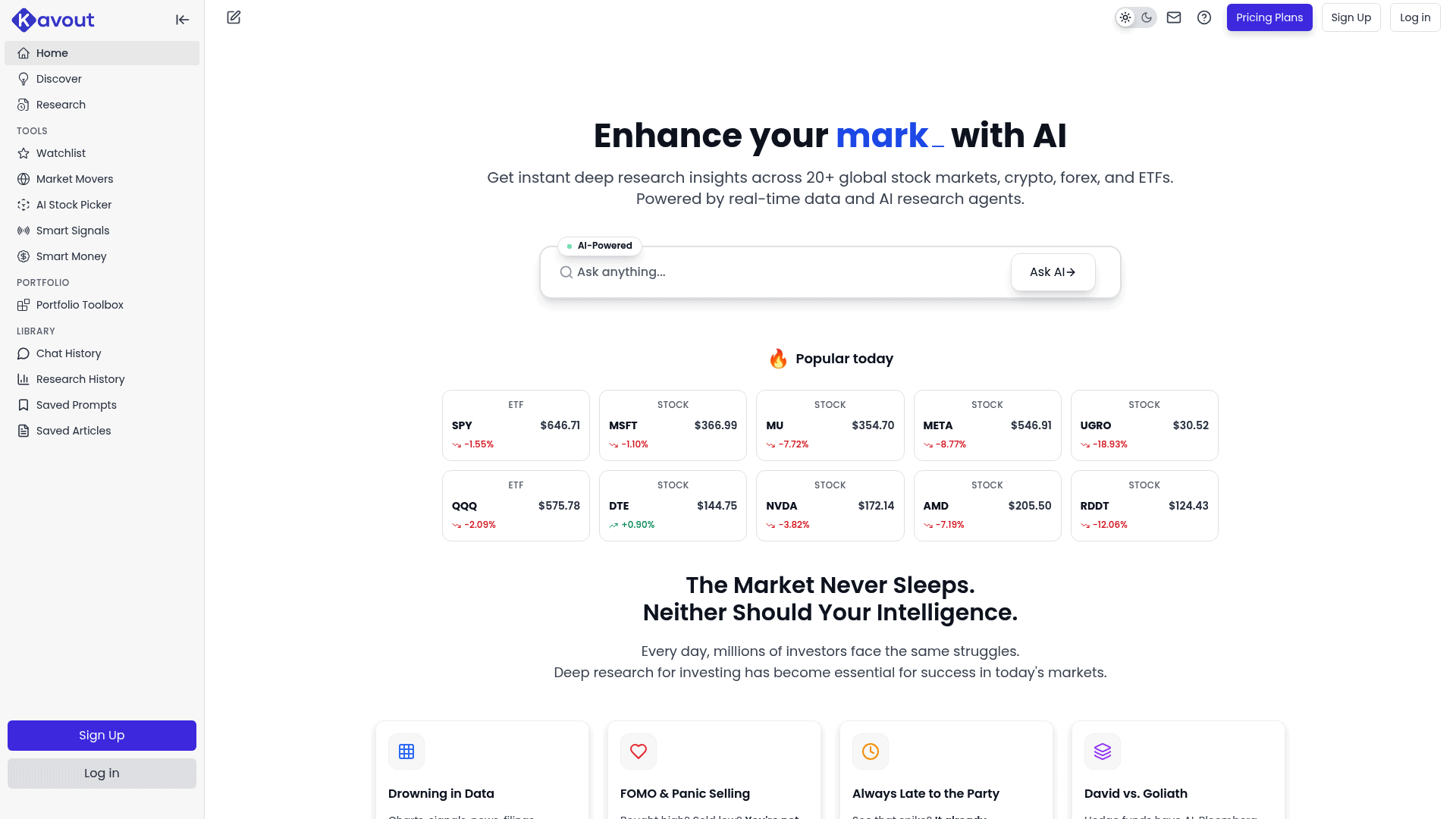
Kavout is the closest thing to a Wall Street quant shop that retail investors can access. The platform runs seven specialized AI research agents that analyze stocks, crypto, forex, and ETFs across 20+ global markets.
What it does best: The Kai Score system aggregates billions of data points (everything from SEC filings to satellite imagery) into a simple 1-9 rating. High scores historically outperform the market. Low scores underperform. It’s that straightforward.
Key features:
- InvestGPT: A 24/7 AI analyst that answers any market question with real-time data
- Smart Money Tracker: Follows what insiders, analysts, Congress members, and billionaires are buying
- AI Stock Picker: Daily rankings from 9,000+ U.S. stocks
- Portfolio Toolbox: Factor-tilted portfolio building with risk diagnosis
Pricing: Not publicly listed. You’ll need to contact sales, which is annoying. Based on comparable platforms, expect $50-150 per month.
Behavioral benefit: The Kai Score removes emotional stock-picking. You get a data-only signal that doesn’t care about your gut feelings or what you read on Reddit last night.
Who should skip it: Passive investors who don’t understand factor investing. If you don’t know what “value momentum” means, this tool will overwhelm you.
The bottom line: Closest thing to institutional-grade quant analysis for retail investors. The lack of transparent pricing is frustrating, but the tool itself is powerful.
2. Fiscal.ai (formerly FinChat.io)

Fiscal.ai rebranded from FinChat.io in late 2025, but the core product remains the same: institutional-quality fundamental data with AI-powered research layered on top. The platform serves over 350,000 investors and is trusted by heavyweights like Morgan Stanley, VanEck, and Salesforce.
What it does best: Verified data with source auditability. Every number links directly back to the original SEC filing. No hallucinations. No guessing.
Key features:
- Global coverage: 100,000+ stocks, ETFs, and funds
- KPI tracking: Company-specific business segments and metrics for 2,500+ companies
- 13F data: Track what major investors are buying and selling
- Click-thru auditability: Click any number to see the source filing
- No latency: Data available within minutes of filing
Pricing:
| Plan | Monthly | Annual | Key Features |
|---|---|---|---|
| Free | $0 | $0 | 10 years financials, 1 dashboard, 1 event |
| Pro | $39 | $468 | 15 years financials, 10 dashboards, equity research |
| Max | $79 | $948 | Unlimited dashboards, export capability, audit to filing |
| API | Contact sales | Contact sales | Full data API access |
Behavioral benefit: Forces you to verify claims with actual filings. This prevents the confirmation bias that leads investors to seek out data that supports their existing positions.
Who should skip it: Day traders and crypto speculators. This is a fundamental research tool, not a momentum scanner.
The bottom line: Like having a Goldman Sachs junior analyst who never sleeps and cites every source. The free tier is genuinely useful, which is rare.
3. Prospero.ai
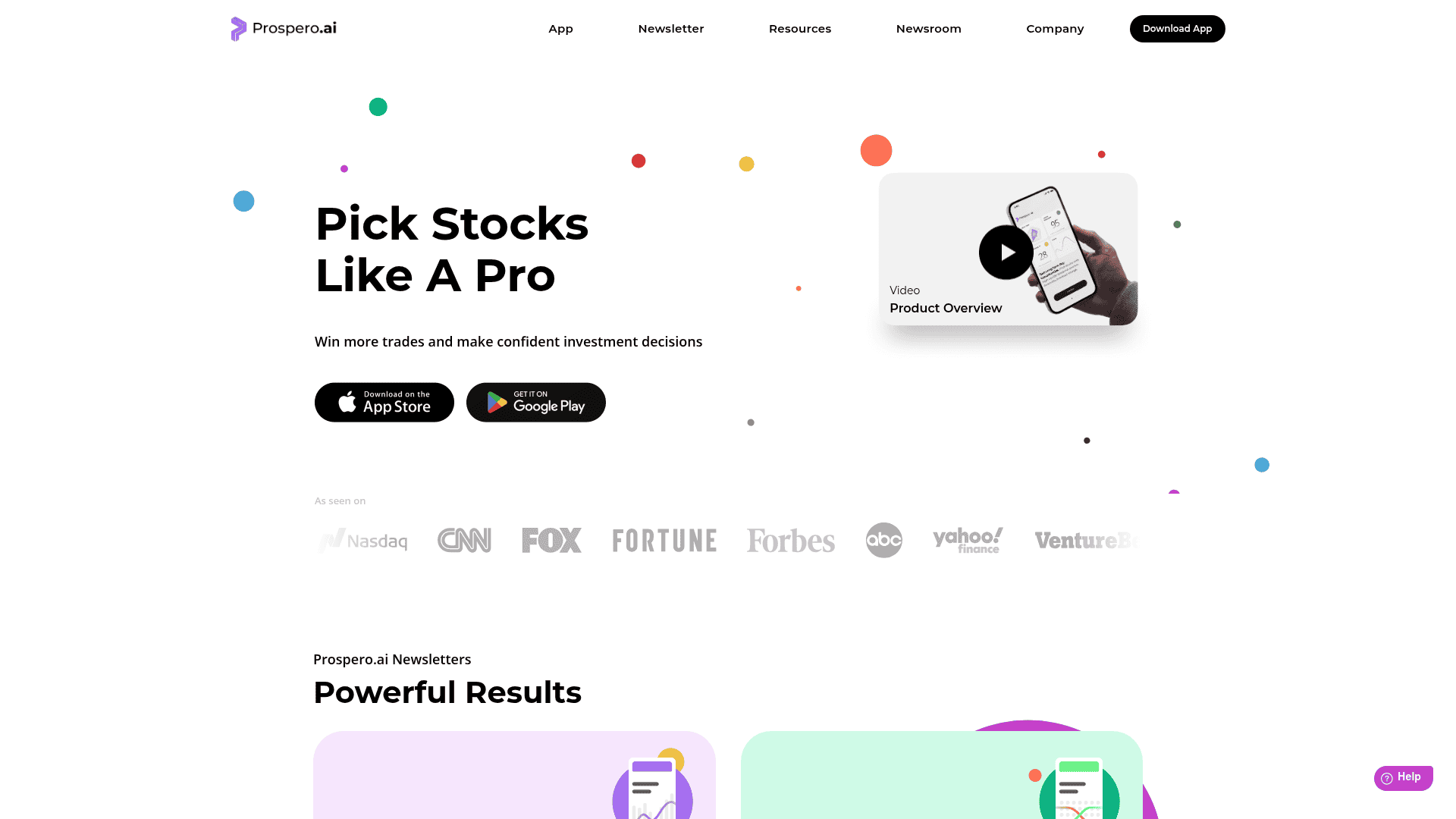
Prospero.ai has one major differentiator: it’s completely free. The platform claims to have outperformed the S&P 500 by 12.9x since inception, and unlike most “free” tools, there’s no upsell pressure because there are no paid tiers.
What it does best: Delivering institutional-quality signals at zero cost. The platform analyzes 100+ million data points using 10,000+ AI/ML models.
Key features:
- Signal-driven picks: AI-powered stock recommendations based on institutional data
- Trend recognition: Pattern detection across market movements
- “Our Picks”: Curated list focusing on the top 20% of stocks
- Mobile apps: iOS and Android for on-the-go analysis
Performance claims:
- 60% win rate for 2025 picks vs. S&P 500
- 81% annualized beat of S&P 500 (as of July 2025)
- 12.9x total outperformance since inception
Pricing: FREE. No tiers. No upsells. The company is funded through a crowdfund campaign on Republic.
Behavioral benefit: The free access removes “sunk cost” pressure. You won’t feel compelled to justify a $100/month subscription by overtrading.
Who should skip it: Investors who need hand-holding or extensive educational resources. The app assumes you know what you’re doing.
The bottom line: Best free option that actually competes with paid tools. The performance claims are aggressive, but at zero cost, you can verify them yourself without risk.
4. Tickeron
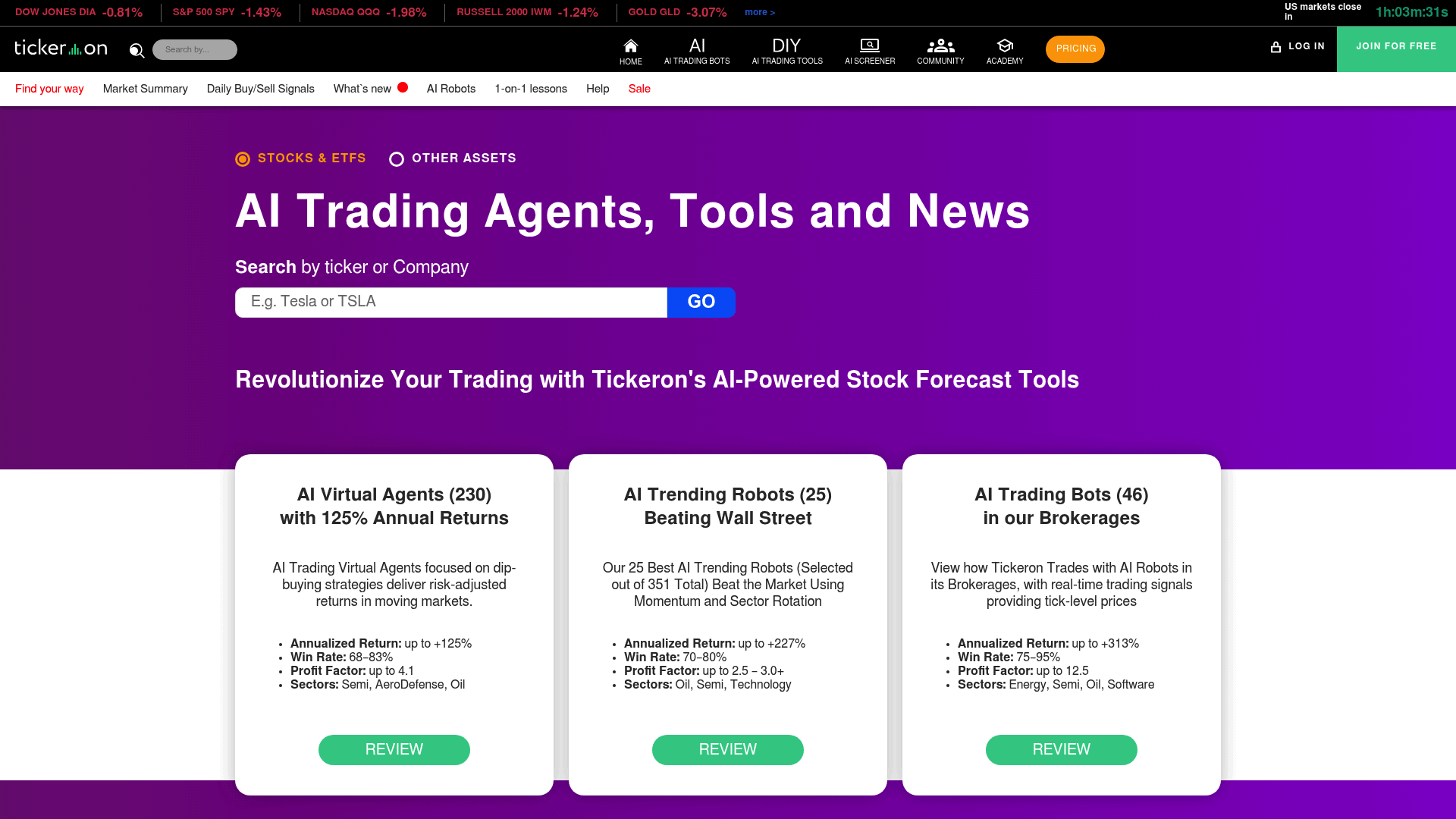
Tickeron is built for technical traders who want AI-powered pattern recognition and automated execution. The platform offers 230+ AI “robots” (their term for algorithmic trading strategies) across stocks, ETFs, crypto, and forex.
What it does best: Pattern recognition at scale. The AI scans thousands of charts 24/7 and identifies breakout patterns with confidence levels based on historical backtesting.
Key features:
- AI Virtual Agents: 230+ agents with claimed annual returns up to 125%
- AI Trending Robots: 25 momentum strategies with up to 227% annualized returns
- Real-Time Patterns: Live pattern detection for day trading
- Trend Prediction Engine: Entry/exit prices with confidence levels
- Daily Buy/Sell Signals: End-of-day trade ideas via machine learning
Performance claims:
- Up to 125% annualized returns (virtual agents)
- Up to 313% annualized returns (trading bots)
- 68-83% win rates on various strategies
Pricing: Not publicly listed. Contact sales required.
Behavioral benefit: Confidence levels remove FOMO. When the AI says a pattern has a 75% historical success rate, you can trade with discipline instead of gambling on gut feelings.
Who should skip it: Long-term investors and fundamental analysts. This is a technical trading platform, not a research tool.
The bottom line: Cold, clinical, data-driven. Doesn’t care about news narratives or CNBC headlines. If you’re a pattern trader, this is worth investigating despite the hidden pricing.
5. Danelfin
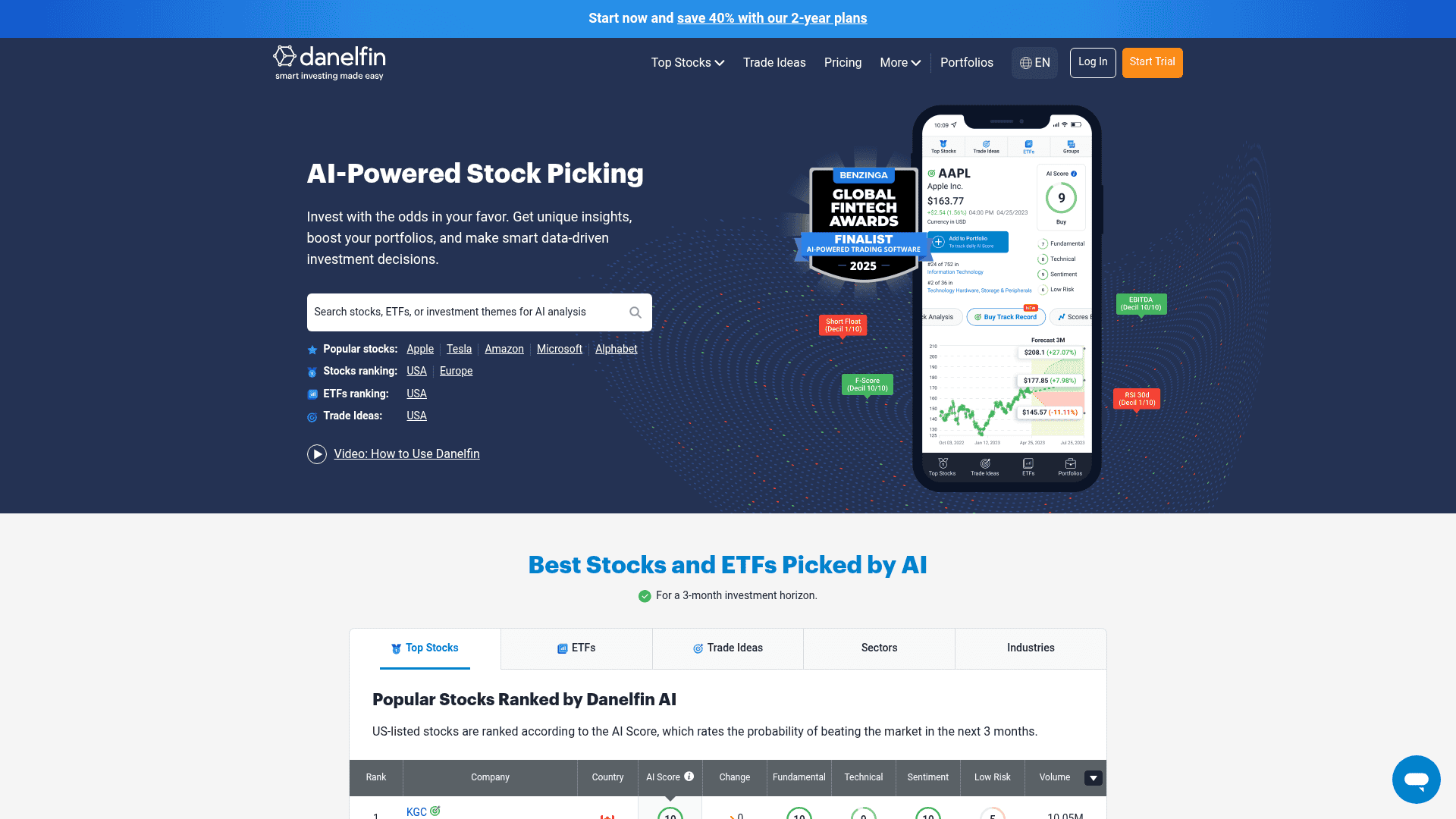
Danelfin uses “explainable AI” (XAI) to rate stocks on a 1-10 scale indicating probability of beating the market. With over 100,000 users globally, it’s one of the more popular AI stock pickers for retail investors.
What it does best: Transparency. Unlike black-box algorithms, Danelfin shows you exactly which features (alpha signals) contributed to each score.
Key features:
- AI Score (1-10): Probability of beating market in 3 months
- Multi-factor analysis: Technical, fundamental, and sentiment subscores
- Trade Ideas: Historical track record with win rates for each signal
- Portfolio tools: Average AI Score, diversity score, upgrade/downgrade alerts
- AI Price Forecast: 1M, 3M, 6M price predictions
Performance claims:
- +376% return (Danelfin Best Stocks strategy, 2017-2025)
- +166% S&P 500 return (same period)
- +21.05% average outperformance (AI Score 10 stocks)
Pricing:
| Plan | Monthly | Annual | Key Features |
|---|---|---|---|
| Free | $0 | $0 | Top 10 stocks, 10 reports/month, 1 portfolio |
| Plus | $22 | $264 | Unlimited reports, 3 portfolios, 25 trade ideas |
| Pro | $59 | $708 | 10 portfolios, unlimited trade ideas, CSV export |
| Elite | $134 | $1,608 | Unlimited everything, API access, historical data |
Behavioral benefit: Transparency builds trust. When you understand WHY the AI made a recommendation, you’re less likely to second-guess it during market volatility.
Who should skip it: Day traders. The AI Score updates daily, which is too slow for intraday trading.
The bottom line: Ultimate second opinion when your gut disagrees with data. The explainable AI approach is refreshing in a field full of black boxes.
6. Composer
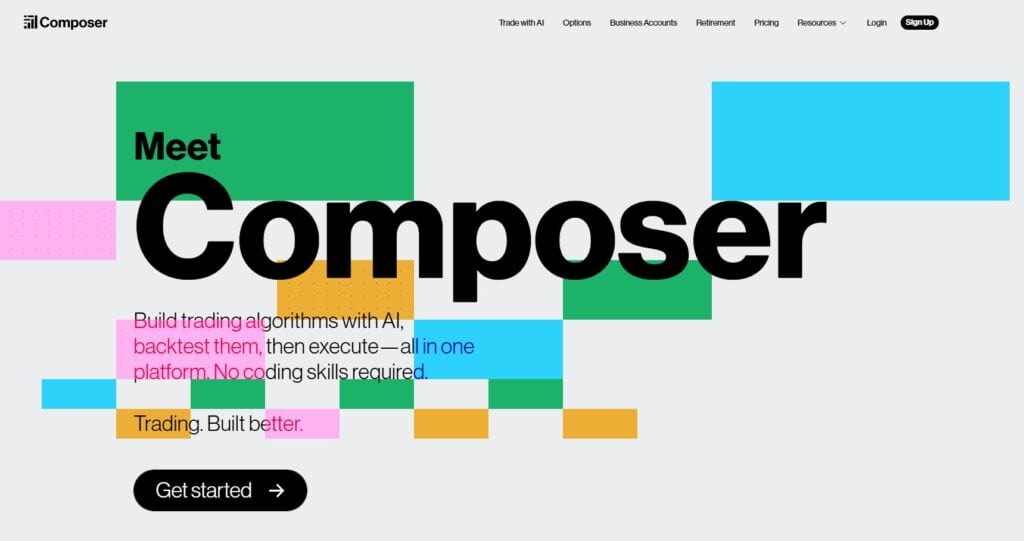
Composer lets you build, backtest, and execute trading algorithms without writing code. Founded in 2020, the platform has executed over $28 billion in trading volume and 15 million+ orders.
What it does best: Democratizing quant strategies. You describe your strategy in plain English, and the AI builds the algorithm for you.
Key features:
- AI strategy creation: Natural language to trading algorithm
- No-code editor: Visual strategy builder with drag-and-drop
- Automated execution: Trades and rebalancing run automatically
- Backtesting: Test strategies against benchmarks
- Community: Copy and remix others’ strategies
- Retirement accounts: Roth and Traditional IRA support
Pricing:
| Plan | Price | Features |
|---|---|---|
| Free | $0 | Trade stocks/ETFs/options manually, AI trade ideas, strategy builder |
| Trading Pass | $32/month ($384/year) | Fully automated trading, unlimited backtesting, retirement accounts |
| Business | Contact sales | API access, funds/entities, priority support |
Behavioral benefit: Removes emotion by setting rules while you’re calm. The algorithm executes your strategy even when fear or greed would normally cause you to deviate.
Who should skip it: Investors who want to “feel” their trades. If you enjoy the process of manually executing orders, automation will feel sterile.
The bottom line: Empowers the retail quant without coding skills. The free tier lets you build and test strategies; the Trading Pass unlocks true automation.
7. AltIndex
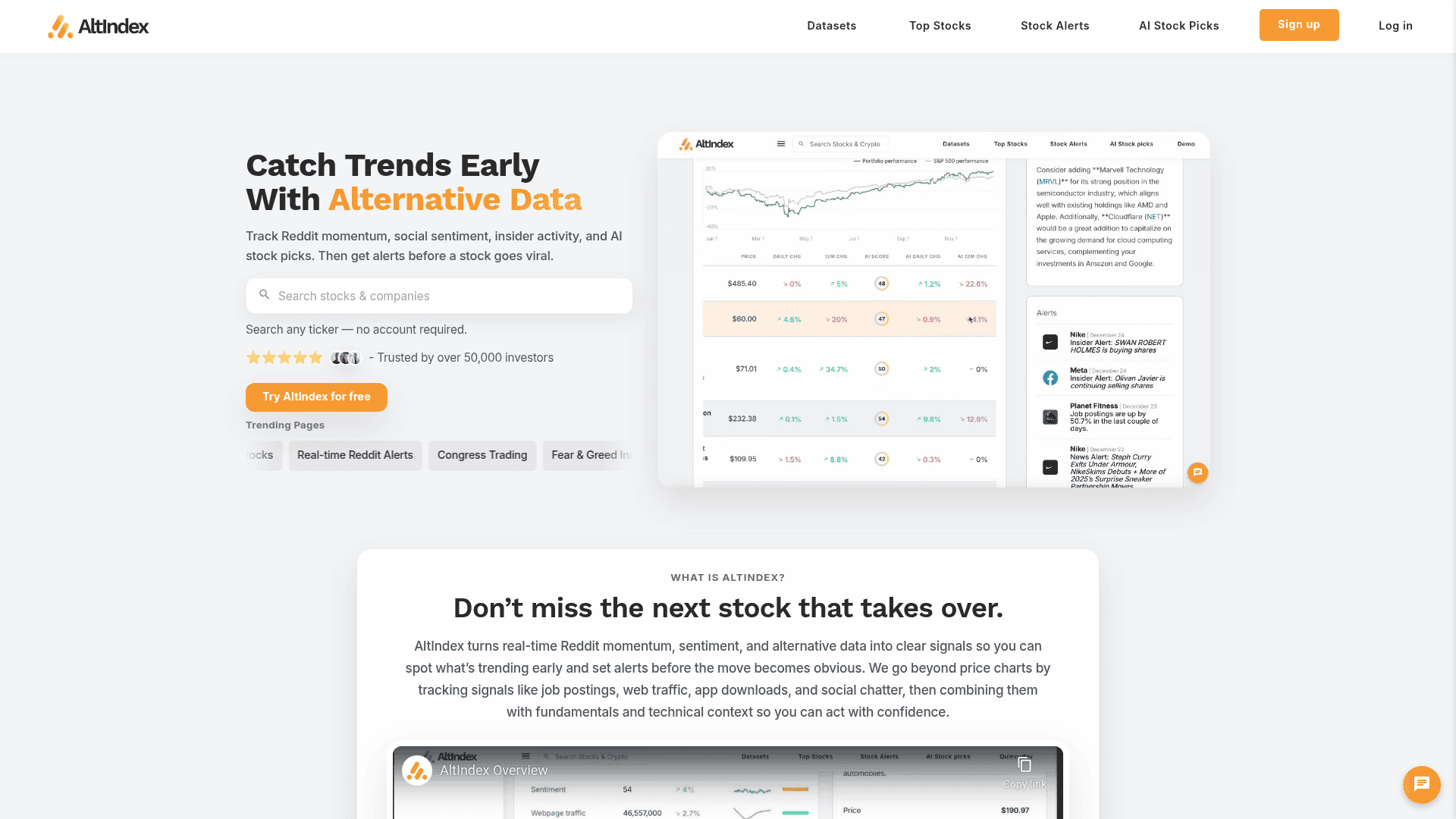
AltIndex takes a different approach from traditional financial analysis. Instead of just looking at earnings reports and balance sheets, it analyzes alternative data sources like social media sentiment, job postings, and credit card transactions.
What it does best: Finding signals in non-traditional data. While other investors are reading the same 10-Ks, AltIndex is tracking Twitter sentiment and Glassdoor reviews.
Key features:
- Social sentiment tracking: Real-time analysis of social media chatter
- Job posting analysis: Track hiring trends as leading indicators
- Credit card transaction data: Consumer spending patterns
- Website traffic monitoring: Visitor trends for digital-first companies
- AI stock picks: Rankings based on alternative data signals
Pricing:
| Plan | Monthly | Annual | Key Features |
|---|---|---|---|
| Free | $0 | $0 | Limited alerts, basic sentiment |
| Starter | $29 | $290 | Full dashboard, 10 stock alerts |
| Pro | $79 | $790 | Unlimited alerts, API access, historical data |
Behavioral benefit: Alternative data helps you avoid herd mentality. When everyone is reading the same news, you’re seeing data they don’t have.
Who should skip it: Traditional value investors who prefer analyzing financial statements over social media trends.
The bottom line: Best for investors who want an edge through unconventional data sources. The free tier is limited but gives you a taste of the platform’s capabilities.
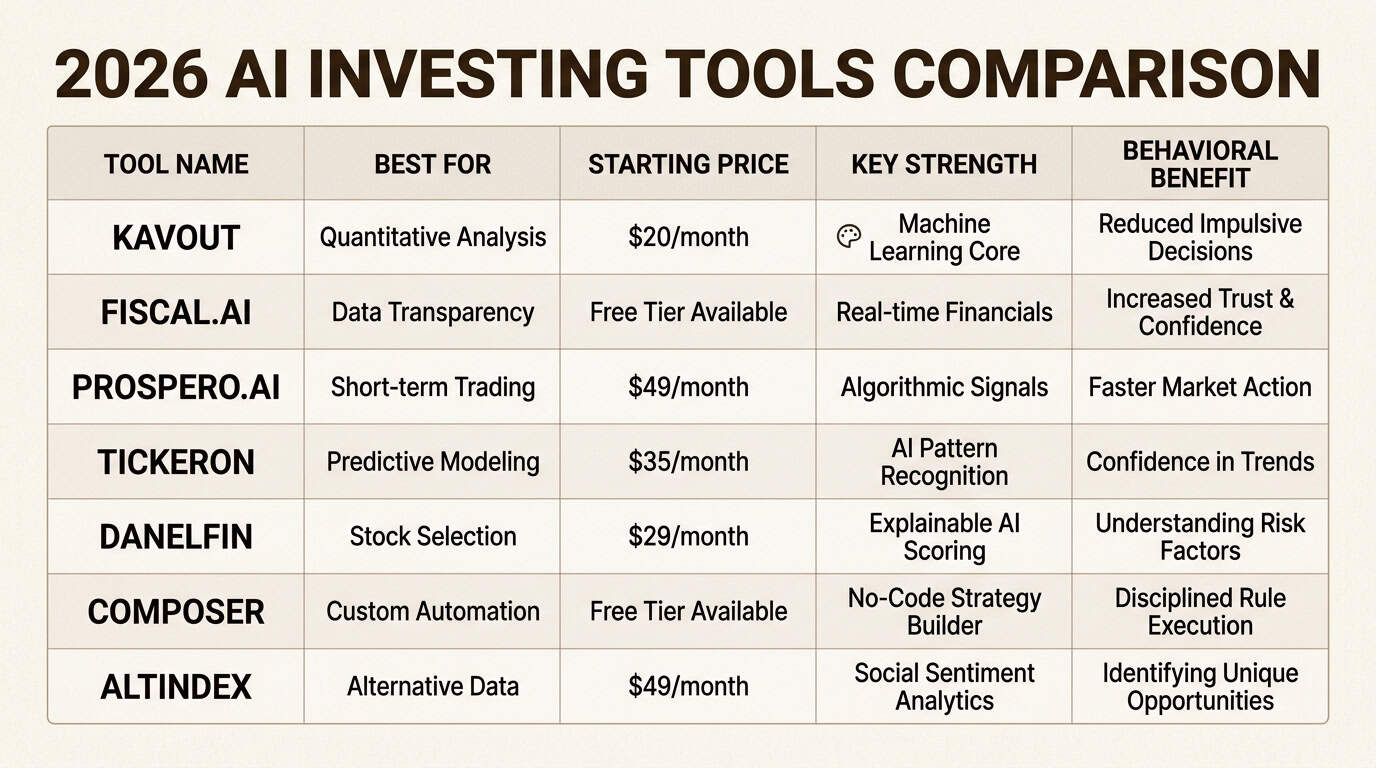
Quick comparison: all 7 tools at a glance
The honest truth about AI investing tools
Before you sign up for any of these platforms, you need to understand something important: even the best AI tools underperform a competent human analyst.
Wall Street Prep ran rigorous tests on AI financial modeling tools in 2025. The winner, Shortcut (now discontinued), scored 5.9 out of 10. Claude came in second at 5.5. For context, a lower-tier human analyst scores around 6.5.
Here’s what that means in practice: AI is great for getting from 0% to 60% complete on research. It’s terrible for finishing the job. You still need to verify every financial figure, check the footnotes, and apply your own judgment.
The real value of AI investing tools isn’t stock picks. It’s behavioral bias mitigation.
Consider these statistics:
- Emotions drive 80% of retail investor losses
- Overconfidence and loss aversion cost self-directed investors ~3 percentage points annually
- DIY investors using AI tools earned 14% higher returns than manual researchers
The AI isn’t making you smarter. It’s stopping you from being stupid.
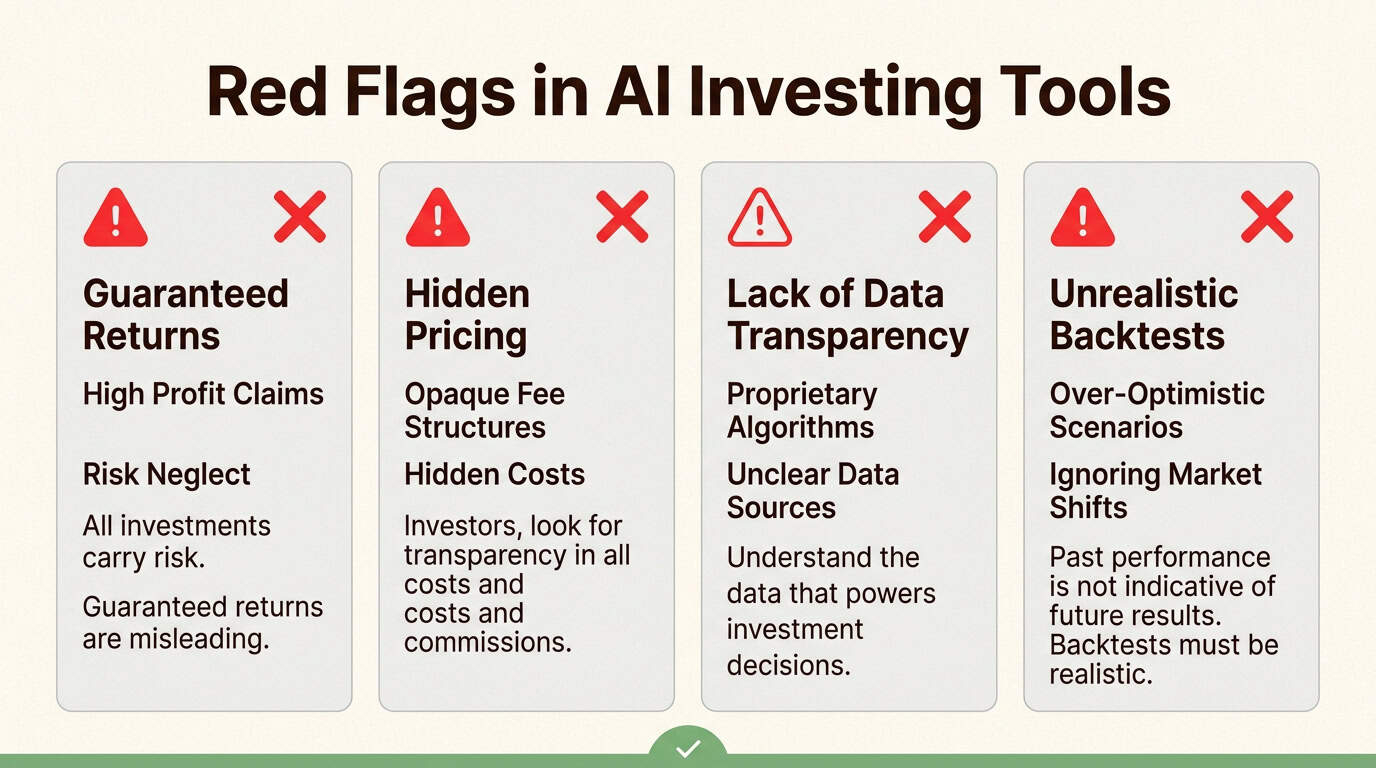
Warning signs of AI tool scams:
- “Guaranteed returns” claims (run away immediately)
- Hidden pricing behind “contact sales”
- No transparency on data sources
- Overfitted backtests showing 500%+ annual returns
Building your AI investing stack
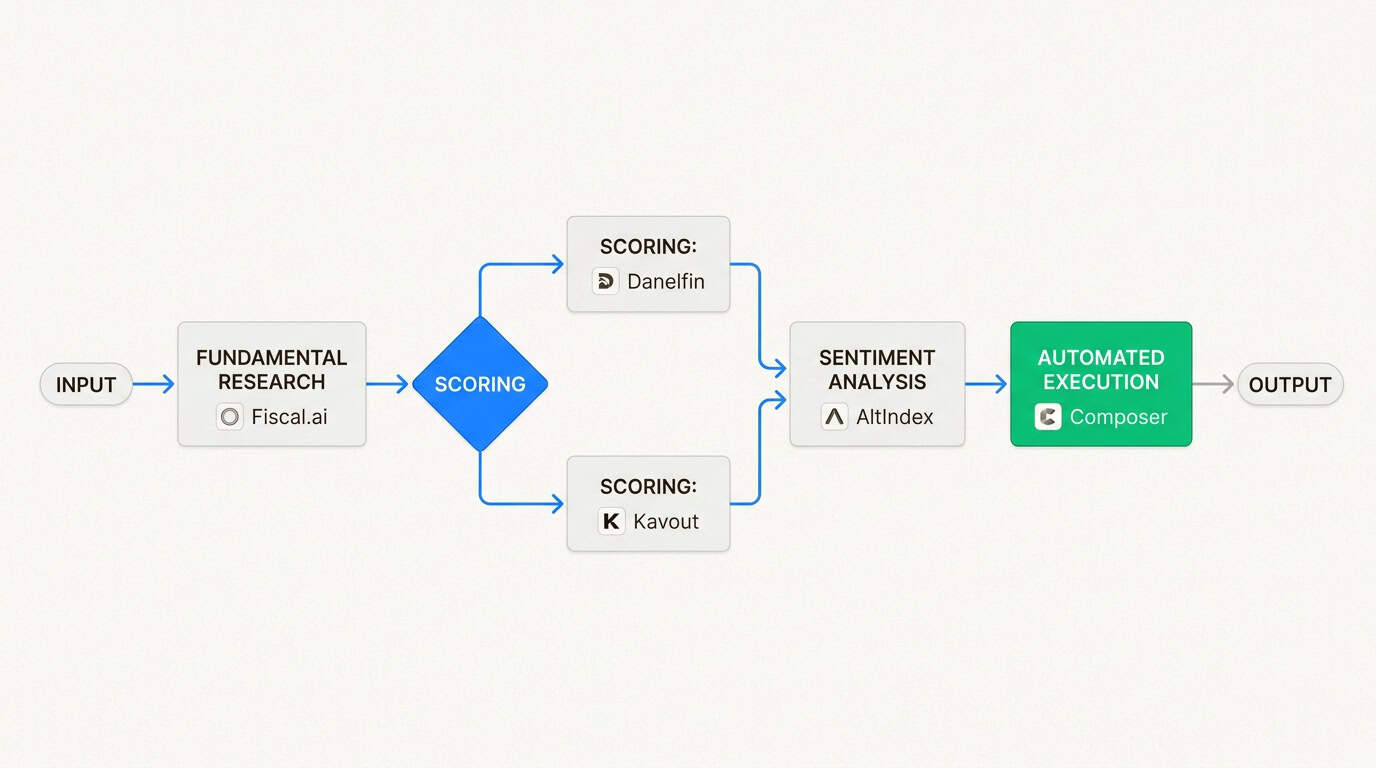
The most successful investors use a “stack approach” rather than relying on a single tool. Here’s a proven combination:
For macro thesis and red-teaming: ChatGPT or Claude. Use these to stress-test your investment ideas and find holes in your logic.
For company deep-dives: Fiscal.ai. The verified data and source auditability are non-negotiable for serious research.
For timing and scoring: Danelfin or Kavout. Use the AI Score or Kai Score as a filter, not a decision-maker.
For automation: Composer. Set your rules while you’re calm, then let the algorithm execute while you sleep.
For alternative perspectives: AltIndex. Check sentiment and alternative data to see what the crowd is missing.
60% of AI tool adopters use 2+ platforms. There’s a reason for that. No single tool does everything well.
Making smarter investment decisions with AI
Let’s recap what we’ve covered:
- Kavout offers the most institutional-grade quant analysis, but pricing is opaque.
- Fiscal.ai provides verified fundamental data with genuine free tier utility.
- Prospero.ai is completely free and claims impressive performance (verify it yourself).
- Tickeron dominates technical pattern recognition for active traders.
- Danelfin delivers transparent, explainable AI scores you can actually understand.
- Composer democratizes algorithmic trading without requiring coding skills.
- AltIndex finds signals in alternative data that traditional analysis misses.
The key takeaway: AI won’t make you a genius investor, but it can stop you from making stupid emotional decisions.
Start with Prospero.ai (free) or Danelfin (transparent pricing) to test the waters. Once you understand how these tools fit your workflow, consider adding specialized platforms for your specific strategy.
Remember: disciplined process beats shiny tools every time. The AI is a tool, not a replacement for thinking.
Frequently Asked Questions
Do you need to pay for the best AI tools for investors in 2026?
Not necessarily. Prospero.ai is completely free and competitive with paid alternatives. Fiscal.ai, Danelfin, Composer, and AltIndex all have genuinely useful free tiers. The paid features are nice-to-haves, not must-haves for most investors.
Which AI investing tool is best for beginners?
Danelfin or Prospero.ai. Both have intuitive interfaces and explain their recommendations clearly. Avoid Tickeron and Kavout until you understand technical analysis and factor investing.
Can AI tools for investors in 2026 actually beat the market?
Some claim to, but verify everything. Danelfin publishes historical performance data showing +376% returns vs. +166% for the S&P 500 since 2017. Prospero.ai claims 12.9x outperformance. These are impressive numbers, but past performance doesn’t guarantee future results.
What’s the biggest mistake people make with AI investing tools?
Treating AI recommendations as gospel. These tools are research assistants, not oracles. Always verify the data, understand the methodology, and make your own decisions.
How do I avoid scams when choosing AI investing tools?
Watch for guaranteed return claims, hidden pricing, and overfitted backtests showing unrealistic performance. Legitimate tools show their work and acknowledge limitations.
Should I use multiple AI investing tools or just one?
Multiple. Each tool has strengths and weaknesses. Fiscal.ai for fundamentals, Danelfin for scoring, AltIndex for sentiment. Using just one tool gives you a narrow view of the market.
What’s the best free AI tool for investors in 2026?
Prospero.ai is entirely free with no paid tiers. For investors wanting fundamental data, Fiscal.ai’s free tier is surprisingly capable. Danelfin’s free plan is limited but useful for testing the platform.
Keep Reading (Build Your Edge)
If you’re serious about becoming a smarter, less emotional investor, these are your next moves:
- 👉 The “Sovereign Investor” Tech Stack: 7 Tools to Bulletproof Your Wealth in 2026
Build a complete system that protects your capital and sharpens your decision-making. - 👉 M1 Finance Review (2026): Automated “Pie” Investing & a Forestry / Real-Asset Model Portfolio
See how automation and real assets can work together to grow wealth without constant micromanaging. - 👉 Ultimate Guide to Timberland Investing in 2026: 5 Ways to Own Trees
Learn how to invest in one of the most overlooked, steady-growth asset classes.