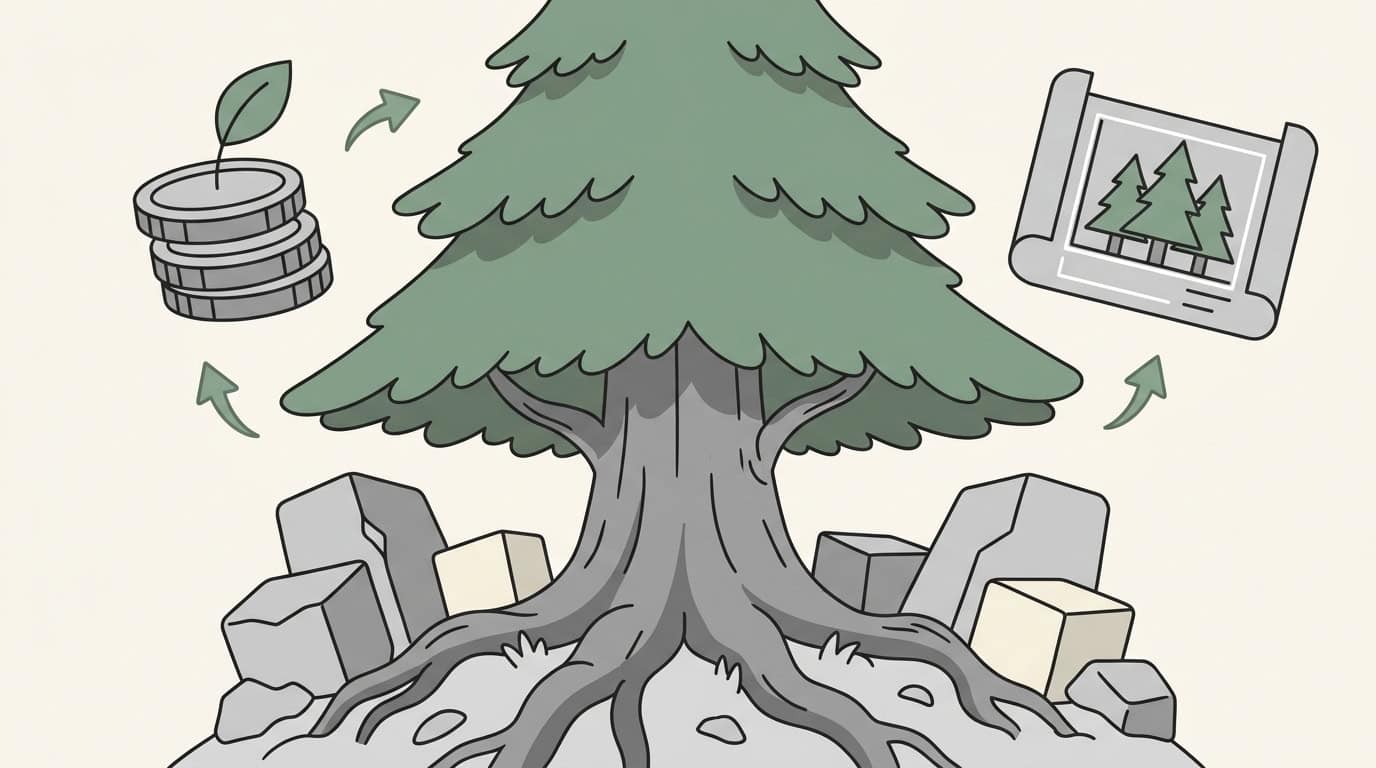
Here’s a fun fact to ruin your next dinner party conversation: while your tech stocks were busy losing 30% because some CEO tweeted the wrong emoji, my trees grew another inch. They didn’t check CNBC. They didn’t panic-sell. They just… grew.
I’ve spent more than 20 years in the woods, hiking through pine stands in the Southeast and old-growth forests in the Pacific Northwest. And I’ll tell you something Wall Street doesn’t want you to hear: trees are better than tech stocks. Not because they’re sexy (they’re not). Not because they’re liquid (they’re definitely not). But because they work while you sleep, they don’t care about Fed policy, and they compound in a way no software company can match.
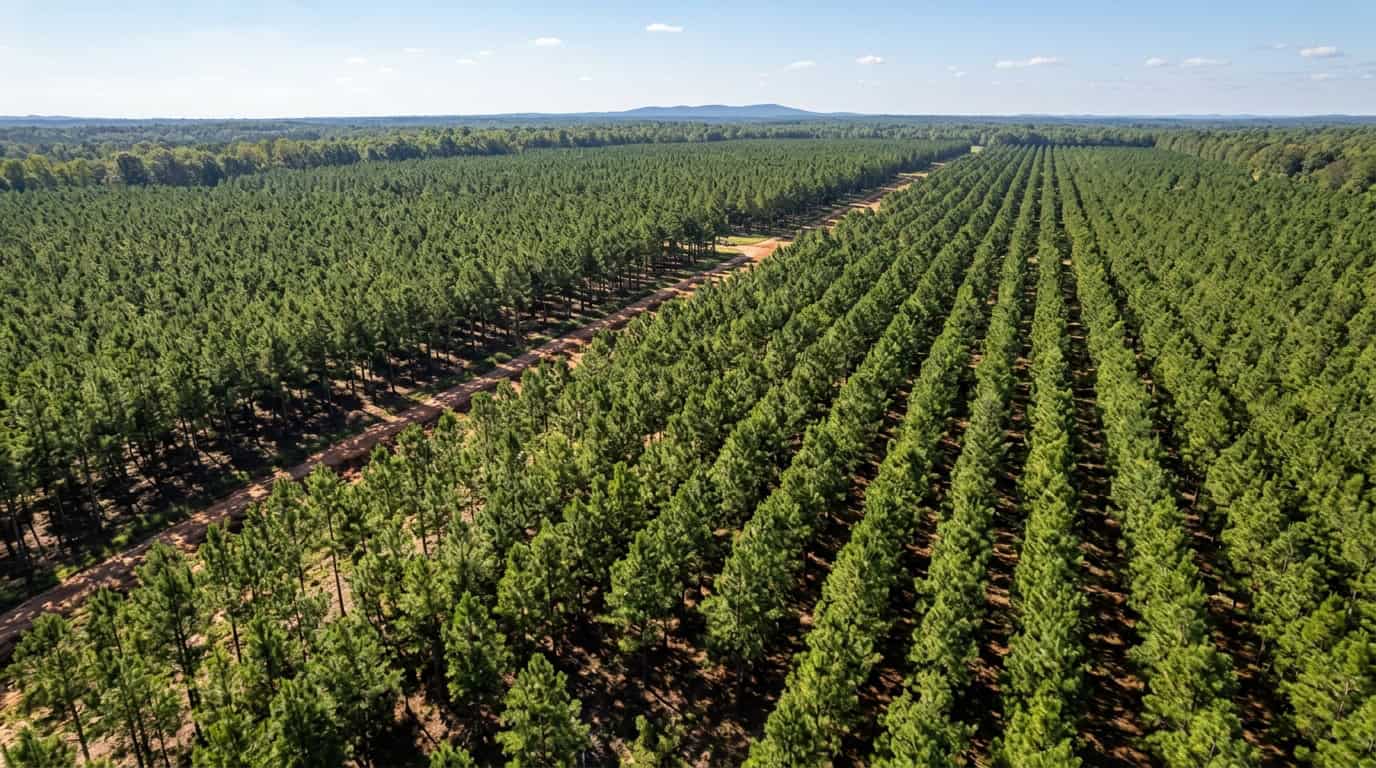
Welcome to timberland investing. It’s not for everyone. But if you’ve got patience and capital you won’t need for a decade or two, it might be the most boring, beautiful investment you’ll ever make.
This guide will show you exactly how to invest in timberland, whether you’ve got $15,000 or $15 million. We’ll cover direct ownership, REITs, TIMOs, and those new fractional platforms that let normal people access an asset class once reserved for pension funds and Yale’s endowment.
If you’re learning how to invest in timberland for the first time, this comprehensive guide covers everything from basic concepts to advanced strategies.
What is timberland investing?
Timberland investing means buying productive forest land with growing trees that will eventually be harvested for profit. It’s that simple and that complex.
When you invest in timberland, you’re buying two things: the land itself and the biological factory growing on top of it. Those trees (softwoods like pine and fir, or hardwoods like oak and maple) are agricultural products. They grow regardless of earnings seasons, interest rate hikes, or what the Nasdaq did today.
Understanding how to invest in timberland starts with recognizing that trees grow independently of market conditions.
The global timber market is worth roughly $344 billion, with the United States claiming about $226 billion of that pie. Most U.S. forestland is privately owned, which means there’s a robust market for buying and selling these assets.
Here’s what makes timberland unique: trees can be “stored on the stump.” When lumber prices crash, you don’t have to harvest. You can wait. The trees keep growing, adding volume and moving into higher-value product classes. Try doing that with a software stock when the market tanks.
Reasons you need to know how to invest in timberland
Still reading? Good. You’re either genuinely curious or desperately trying to diversify after the last market correction. Either way, here are the hard facts about why timberland deserves a place in your portfolio and why knowing how to invest in timberland matters:
- Portfolio diversification with low correlation to stocks and bonds: Timberland returns don’t move in lockstep with the S&P 500. When equities crash, your trees don’t notice.
- Inflation hedge with positive historical correlation: Timber prices tend to rise with inflation. Your trees literally grow more valuable as the dollar buys less.
- Biological growth compounds while you wait: Unlike shares of stock, which stay static in number, trees multiply in volume. A loblolly pine doesn’t care about bear markets.
- Tangible enjoyment you can’t get from a brokerage account: You can hunt, hike, and fish on your investment. Try camping on your Tesla shares.
- Historically less volatile than equities with comparable returns: The NCREIF Timberland Index has delivered 10.74% annualized returns over 35 years with roughly half the volatility of stocks.
How timberland investments actually make money
Let’s talk mechanics. Timberland generates returns through four distinct value drivers, and understanding each is crucial if you want to learn how to invest in timberland effectively.
1. Biological growth (the engine)
This is the primary driver of timberland returns, accounting for roughly 60% of total appreciation. Trees grow every single year, adding volume through a process that requires no R&D budget, no engineering team, and no quarterly earnings calls.
A loblolly pine in the Southeast starts producing merchantable pulpwood around age 15, when it hits about 7 inches in diameter. By age 22, it’s 10 inches and suitable for small-dimension lumber. By age 30, it reaches 14 inches and commands large sawtimber prices. The tree increases in value 300% to 500% during this progression, and that’s before accounting for inflation in timber prices.
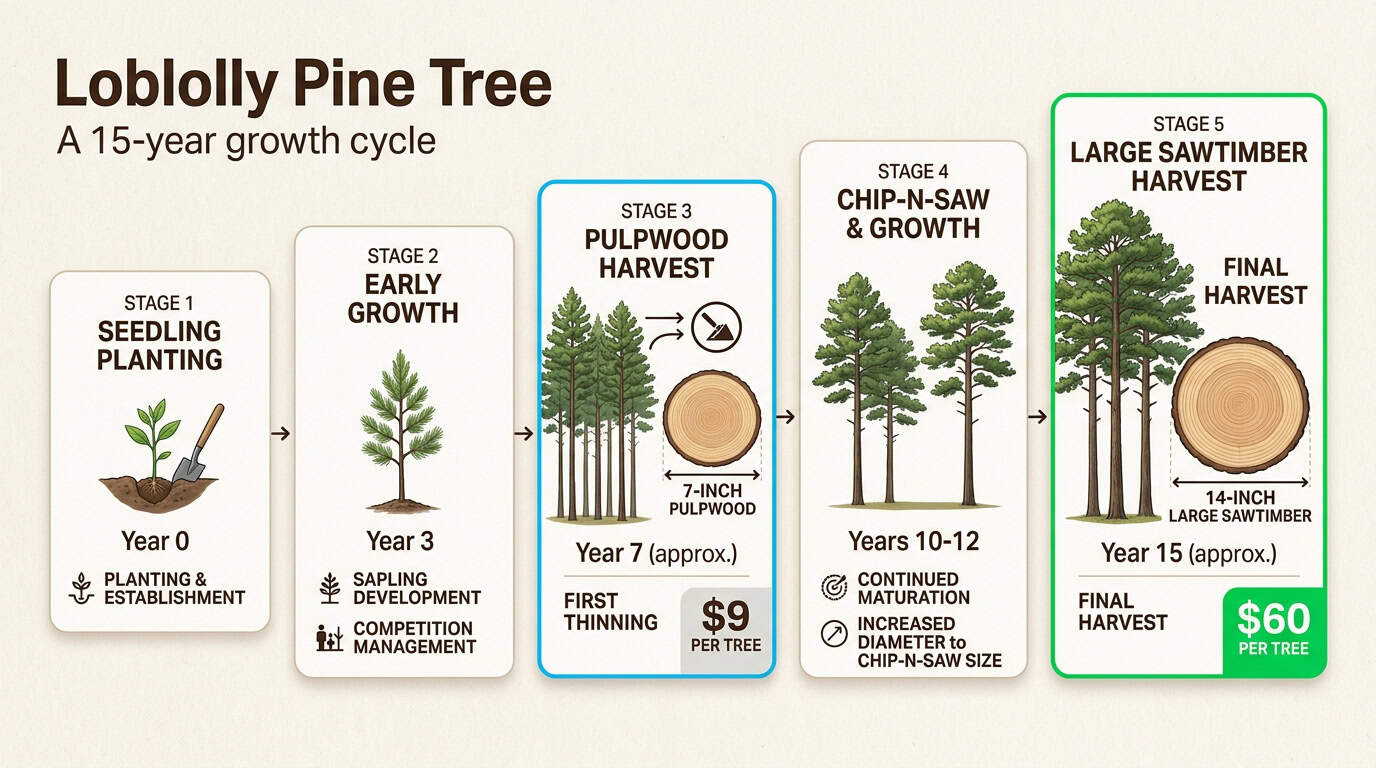
Source: RLI Land Institute – Basics of Timberland Investing
2. Product class movement (the multiplier)
Not all wood is created equal. As trees grow, they graduate into higher-value product classes:
| Product Class | Tree Diameter | Price per Ton | Typical Use |
|---|---|---|---|
| Pulpwood | 7 inches | ~$7 | Paper products |
| Small sawtimber | 10 inches | ~$14 | Dimension lumber |
| Large sawtimber | 14+ inches | ~$30 | High-grade lumber, plywood |
A tree worth $1.50 as pulpwood can be worth $22.50 as large sawtimber. That’s the power of biological growth combined with product class movement.
3. Land appreciation (the kicker)
Land appreciation contributes only 5-10% of total timberland returns in normal markets. However, in rapidly growing regions, timberland can appreciate significantly as it develops “higher and better uses.”
That tract you bought for timber production? In 20 years, it might be worth more as a golf course community, subdivision, or conservation easement. This is the optionality embedded in land ownership.
4. Non-timber income (the bonus)
Smart timberland owners monetize their land while the trees grow. Revenue streams include:
- Recreational leasing (hunting, fishing, camping)
- Carbon credits and verified carbon assets
- Mitigation banking credits
- Mineral rights and royalties
- Road use agreements
- Maple tapping (in northern regions)
Historical performance data
The numbers don’t lie. According to the National Council of Real Estate Investment Fiduciaries (NCREIF) Timberland Index:
| Period | Annual Return | Benchmark |
|---|---|---|
| 35 years (1990-2020) | 10.74% | NCREIF Timberland Index |
| 5 years (2020-2025) | 7.93% | NCREIF Timberland Index |
| Volatility | ~50% of S&P 500 | Comparison studies |
Source: NCREIF, AcreTrader Research
For context, timberland’s volatility is comparable to 10-year Treasury bonds, but with equity-like returns. That’s the holy grail of portfolio construction: return without the ride.
Step-by-step instructions to invest in timberland
Now for the practical part. Here’s how to invest in timberland based on your capital, time horizon, and desired involvement level. Each approach to how to invest in timberland offers different trade-offs between control, liquidity, and minimum investment requirements.
Step 1: Choose your investment vehicle
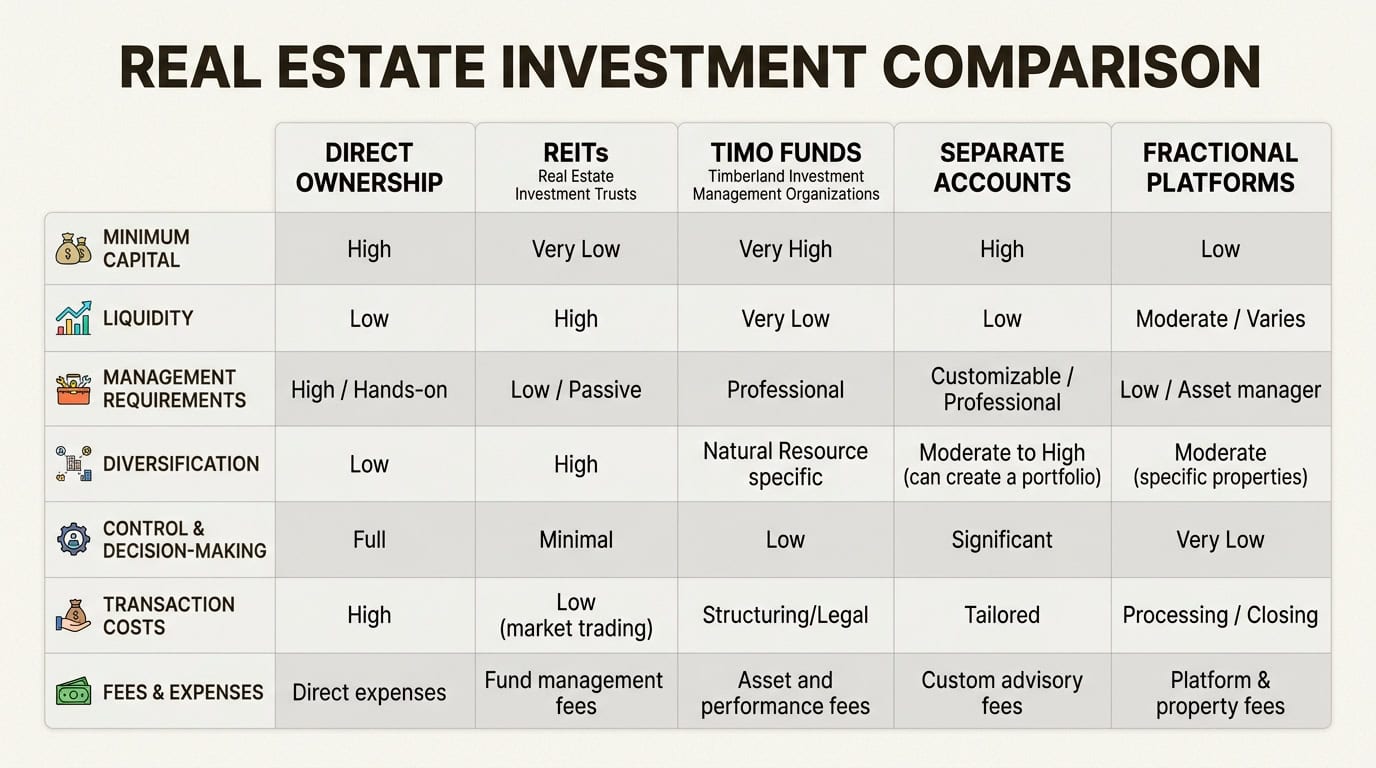
Not everyone can buy 1,000 acres outright. Fortunately, there are five distinct ways to gain timberland exposure when learning how to invest in timberland:
Option A: Direct ownership
Buy the land yourself, 10 acres or 10,000. You control everything: when to harvest, what to plant, whether to allow hunting leases.
- Minimum investment: $50,000 to $500,000+ (depending on region and timber quality)
- Liquidity: Low (6-18 months typical to sell)
- Management: Self-managed or hire a consulting forester
- Best for: Hands-on investors with forestry knowledge or willingness to learn
If you go this route, hire a consulting forester certified by the Association of Consulting Foresters (ACF). Look for someone with a bachelor’s degree in forestry, at least five years’ experience, and no conflicts of interest with timber buyers.
Option B: Timberland REITs
Real Estate Investment Trusts that own and manage timberland portfolios. They trade like stocks, offering instant liquidity and professional management.
The two major publicly traded timberland REITs are:
| REIT | Ticker | Market Cap | 1-Year Return (Mar 2026) |
|---|---|---|---|
| Weyerhaeuser | WY | $17.5B | -14.42% |
| Rayonier | RYN | N/A | -17.75% |
Source: Nareit, Weyerhaeuser Investor Relations
- Minimum investment: $0 (buy one share)
- Liquidity: High (trades daily)
- Management: Professional
- Best for: Investors wanting liquid exposure without the headaches
The downside? You lose the harvest flexibility that makes direct timberland ownership attractive. Plus, REITs correlate more closely with equity markets, increasing volatility.
Option C: TIMO commingled funds
Timber Investment Management Organizations (TIMOs) pool capital from multiple investors to acquire and manage timberland portfolios. The big four TIMOs are Hancock Timber Resource Group, Forestland Group, Campbell Global (now part of J.P. Morgan), and Resource Management Service (RMS).
RMS, for example, manages $5.5 billion in assets with 42 institutional investors and has completed $6.7 billion in forest acquisitions since 2004.
Source: RMS About Page
- Minimum investment: $100,000 to $1 million
- Liquidity: Low (typically 7-10 year fund life)
- Management: Professional TIMO
- Best for: Accredited investors seeking diversification
Option D: TIMO separate accounts
For the truly wealthy, TIMOs offer separate accounts with customized strategies. You’re essentially hiring a timberland management firm to build a portfolio just for you.
- Minimum investment: $30 million+
- Liquidity: Low
- Management: Dedicated professional team
- Best for: Institutions, family offices, ultra-high-net-worth individuals
Option E: Fractional platforms
New platforms like AcreTrader enable fractional ownership of timberland through LLC structures. You buy shares in a single-purpose entity that owns the land.
- Minimum investment: $15,000+ (typical)
- Liquidity: Low (hold periods of 5-10 years)
- Management: Platform handles everything
- Best for: Retail investors wanting direct ownership without the management burden
Step 2: Evaluate regions and timber types
Location matters enormously in timberland investing. The three major U.S. timber regions each have distinct characteristics:
Southeast (Georgia, Alabama, Mississippi, Carolinas)
- Predominantly loblolly pine
- Fastest growth rates (20-30 year rotations)
- Strong pulpwood and sawtimber markets
- Generally lower land costs
Pacific Northwest (Washington, Oregon)
- Douglas fir dominant
- Slower growth but higher-value timber
- Strong export markets (especially China)
- Higher land costs
Northeast (Maine, New Hampshire, Vermont, New York)
- Mixed hardwoods (oak, maple, cherry)
- Northern hardwood species command premium prices
- Slower growth, longer rotations
- Recreational value often exceeds timber value
When evaluating specific properties, consider:
- Proximity to mills: Transportation is your biggest cost. The closer to mills, the higher your net stumpage price.
- Site productivity: Soil quality determines growth rates. Get a site index rating from a forester.
- Access and roads: Can you get equipment in? Are there existing haul roads?
- Property tax rates: Some states heavily favor agricultural/forest land; others tax it like commercial real estate.
Step 3: Conduct due diligence
Never buy timberland without a professional timber cruise. This is non-negotiable. A consulting forester will inventory the standing timber, estimate volume by product class, and project future growth.
Your due diligence checklist should include:
- Timber cruise and inventory (current volume and species mix)
- Soil/site productivity assessment
- Property survey and boundary verification
- Access and easement documentation
- Proximity analysis to mills and markets
- Timber title and deed restrictions (conservation easements, mineral reservations)
- Environmental regulations and wetland delineations
- Property tax history and assessment methodology
Source: AcreTrader Timber Investment Guide
Step 4: Understand the tax implications
Timberland has unique tax advantages that make it particularly attractive for high-income investors.
Capital gains treatment: Timber harvests qualify for long-term capital gains rates if you’ve held the property for more than a year. For high-income investors, that’s 20% federal instead of 37% ordinary income.
Cost recovery through depletion: You can recover your basis in the timber as you harvest, reducing taxable income.
1031 exchange eligibility: Timberland qualifies for like-kind exchanges. Sell one timber property, buy another, defer the capital gains.
Property tax advantages: Most states offer preferential property tax rates for forestland, recognizing its agricultural nature and open space benefits.
Source: RLI Land Institute
Step 5: Plan your exit strategy
Timberland is illiquid. Plan accordingly. Typical hold periods range from 10 to 30 years depending on the age class of timber at acquisition.
Exit options include:
- Land appreciation sale: Sell when the property reaches “higher and best use” (often development)
- Timber value sale: Harvest mature timber, then sell the land
- Conservation easement: Sell development rights for tax benefits while retaining timber rights
- Estate transfer: Pass timberland to heirs (excellent estate planning tool due to step-up in basis)
Key considerations for successfully investing in timberland
Before you write that check, understand what you’re getting into. Timberland investing has unique characteristics that can either be features or bugs depending on your situation.
Time horizon reality check
Timberland is generational wealth building, not swing trading. If you need liquidity in five years, look elsewhere. Loblolly pines need 20-30 years to reach maximum value. Douglas fir can take 40-50 years.
This is “get rich slow” territory. But slow and steady has its advantages.
Environmental risks
Trees are living organisms subject to natural disasters. Your risks include:
- Wildfire (particularly in the West)
- Wind and ice storms
- Insect infestations (mountain pine beetle, emerald ash borer)
- Disease
- Drought
Mitigation strategies include geographic diversification, age class diversification, and insurance. Skilled forest management can reduce many of these risks through proper thinning, controlled burns, and species selection.
Market risks
Timber prices fluctuate based on housing demand (which consumes 65% of softwood lumber), export markets (China is a major buyer of U.S. logs), and Canadian lumber imports.
The 2008 housing crash devastated timber prices. But here’s the thing: if you owned timberland directly, you could wait. The trees kept growing. When prices recovered, you had more volume to sell at higher prices. That’s the biological growth advantage.
Management requirements
Even “passive” timberland investments require oversight. Poor forest management destroys value through overstocking, inadequate thinning, or harvesting at the wrong time.
If you don’t have forestry expertise, hire it. The cost of a consulting forester (typically 5-10% of harvest revenue) pays for itself many times over.
Taking it to the next level: Advanced timberland strategies
Once you understand the basics of how to invest in timberland, consider these advanced strategies that experienced investors use to maximize returns:
Conservation easements: Sell the development rights to your land while retaining timber and recreational rights. You get a significant tax deduction and cash payment, plus reduced property taxes.
Carbon credit programs: Emerging markets for forest carbon credits allow you to get paid for keeping trees standing longer. This is particularly attractive for high-quality hardwood stands.
Mitigation banking: Convert marginal timberland into wetlands or endangered species habitat, then sell mitigation credits to developers who need to offset environmental impacts elsewhere.
Agroforestry combinations: Integrate timber production with other land uses like cattle grazing (silvopasture) or specialty crops (ginseng, mushrooms).
Alternatives to direct timberland ownership
Not ready to buy a forest? You can still gain exposure:
- Timber ETFs: Diversified exposure to timber and paper companies with daily liquidity
- Real assets model portfolios: Some advisors offer timberland allocations through fund-of-funds
- Farmland investing: Similar risk/return profile through platforms like AcreTrader
- REITs with timber exposure: Broader real estate exposure with timberland components
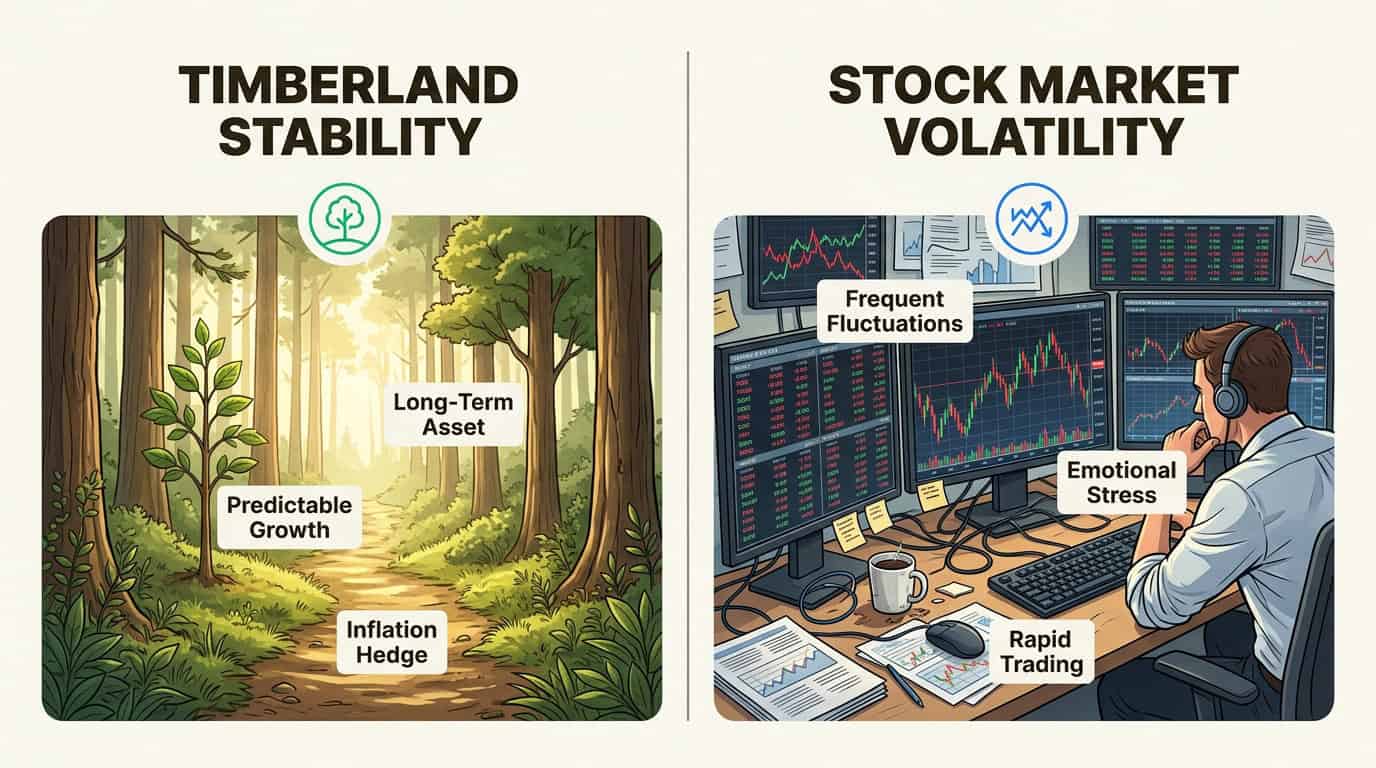
Why trees beat tech stocks (a contrarian’s perspective)
After 20+ years of watching both markets, I’ll make a claim that would get me laughed out of a San Francisco cocktail party: trees are better long-term investments than tech stocks. Here’s my case for why knowing how to invest in timberland could transform your portfolio.
The biological growth advantage
Tech stocks require constant innovation just to maintain their value. Stop innovating, and competitors eat your lunch. Trees just… grow. No engineering team. No R&D budget. No quarterly earnings pressure.
While your SaaS stocks are one platform update away from disruption, my pines add another growth ring.
The patience premium
Tech investors panic at quarterly earnings misses. Timber investors understand that good things take decades. This psychological advantage cannot be overstated.
When you own timberland, you literally cannot panic-sell during a market crash. The illiquidity is a feature, not a bug. It forces patience.
Tangibility matters
You can walk your investment. You can hunt on it, hike through it, show it to your kids. Try bonding with your Robinhood portfolio.
There’s something deeply satisfying about owning a tangible asset that produces oxygen, sequesters carbon, and provides wildlife habitat while it makes you money.
Inflation protection
When dollars lose value, trees keep growing. Timber prices have historically tracked inflation. Meanwhile, tech companies struggle to raise prices without losing customers.
The behavioral edge
Studies consistently show that investor behavior destroys returns. We buy high, sell low, and chase performance. Timberland’s illiquidity prevents all of these mistakes.
You can’t check your timberland’s price on your phone. You can’t sell it in a panic at 2 AM. You’re forced to be a long-term investor.
| Metric | Timberland | Tech Stocks |
|---|---|---|
| Volatility | Low | High |
| Correlation to equities | Low | High |
| Time horizon | Decades | Quarterly |
| Inflation hedge | Strong | Mixed |
| Tangibility | Physical | Digital |
| Management required | Periodic | Constant |
Start building your timberland investment strategy today
If you’ve read this far, you’re either seriously considering timberland or researching it for a term paper. Either way, here’s your action plan for how to invest in timberland starting today.
Step 1: Assess your capital and time horizon. If you need the money in five years, buy REITs. If you’ve got 15+ years and $15,000+, consider fractional platforms. If you’ve got $500,000+ and 20 years, look at direct ownership as you learn how to invest in timberland.
Step 2: Decide on your involvement level. Do you want to learn forestry and manage properties yourself? Or do you want completely passive exposure? Your answer determines your vehicle.
Step 3: Research your preferred access method. If going direct, start visiting properties with a consulting forester. If using REITs, compare WY and RYN. If using fractional platforms, review AcreTrader’s timberland offerings.
Step 4: Connect with professionals. For direct ownership, find an ACF-member forester. For TIMO access, contact RMS or Campbell Global. For education, join the Realtors Land Institute.
Step 5: Start small if needed. You don’t need to buy 1,000 acres on day one. Buy a timberland REIT. Invest $15,000 through a fractional platform. Learn the asset class before committing serious capital.
Final reminder: this is not a get-rich-quick scheme. It’s a get-rich-slow, sleep-well-at-night strategy for patient capital. Trees don’t care about your urgency. They grow on their own schedule, and that schedule is measured in decades, not quarters. That’s the beauty of learning how to invest in timberland.
But if you can embrace that pace, timberland offers something rare in modern investing: true diversification, inflation protection, and the quiet satisfaction of owning something real. Once you master how to invest in timberland, you’ll wonder why more people don’t allocate to this asset class.
At The Witty Investor, we believe investing is hard, but being bad at it is optional. Whether you’re building a Bunker Portfolio for volatile times or just looking for alternatives to overheated tech stocks, learning how to invest in timberland deserves your consideration.
Subscribe to our Investor’s Playbook for more unconventional investment research, or check out our YouTube channel where we break down complex topics with (you guessed it) insight, clarity, and just enough sarcasm.
Frequently Asked Questions
Do you need to be an accredited investor to learn how to invest in timberland effectively?
No. While many TIMO funds require accredited investor status, anyone can buy timberland REITs like Weyerhaeuser (WY) or Rayonier (RYN) through a regular brokerage account. Fractional platforms like AcreTrader also offer access to non-accredited investors for certain offerings.
What is the minimum amount needed to start investing in timberland through direct ownership?
For direct ownership, plan on at least $50,000 to $100,000 for a small parcel (10-20 acres) in the Southeast, though $500,000+ opens up more attractive institutional-quality properties. Alternatively, fractional platforms allow entry at around $15,000.
How does timberland compare to farmland when considering where to invest in real assets?
Both offer inflation protection and low correlation to stocks, but timberland has unique advantages: harvest flexibility (you can delay cutting when prices are low) and lower annual management intensity. Farmland produces annual crops; timberland can sit undisturbed for years while still appreciating.
What tax advantages should I know about before I invest in timberland directly?
Direct timberland ownership offers significant tax benefits including capital gains treatment on harvests (20% rate vs. 37% ordinary income), cost recovery through depletion, 1031 exchange eligibility, and preferential property tax rates in most states.
Is timberland a good investment for someone nearing retirement who wants to learn how to invest in alternative assets?
Timberland is generally better suited for investors with long time horizons (10+ years). If you’re nearing retirement, timberland REITs provide exposure with the liquidity you might need. Direct timberland ownership ties up capital for years, making it less suitable for retirees who may need access to their funds.
What are the biggest risks I should understand before I invest in timberland for the first time?
The primary risks include illiquidity (6-18 months to sell), environmental hazards (fire, insects, disease), and market price volatility for lumber. Geographic diversification and professional forest management can mitigate many of these risks.
How can a beginner start to invest in timberland without becoming a forestry expert?
Start with timberland REITs for exposure without management burden. As you learn, consider fractional platforms that handle all management. If you eventually want direct ownership, always hire a consulting forester certified by the Association of Consulting Foresters (ACF) to guide your decisions.
Smart Reads for Investors Who Don’t Like Losing Money
Prepper Stocks 2025: Profit from the Survival Industry Before It Goes Full Mad Max
→ Because if trees are the calm, quiet investment… these are the loud, chaotic cousins that profit when things get weird.
7 Stocks to Pretend You Found Before Everyone Else
→ For when you want the illusion of genius… instead of the slow, boring reality of watching trees grow for 20 years.
Market Panic Investing: How Smart Investors Profit When Everyone Else Loses Their Minds (2025 Edition)
→ Pairs perfectly with timberland’s “do nothing and win anyway” strategy when the market is having a meltdown.