10 Brutal Truths About Retirement Savings at 45 (And How to Fix It)
Building retirement savings at 45 requires confronting the harsh math of late starts, utilizing aggressive catch-up contributions, and maximizing peak earning years to secure your future. Managing your retirement savings at 45 means rewriting the standard financial playbook that assumes a 40-year runway. Accelerating your retirement savings at 45 takes deliberate, aggressive action to bridge the compounding gap.
At-a-Glance Summary
- The Reality Check: Starting at 45 means missing out on the first two decades of compounding interest.
- The Solution: Maximizing tax-advantaged accounts, traditional catch-up limits, and peak earning power.
- The Target: Shifting from passive monthly contributions to aggressive, intentional wealth accumulation.
Every retirement calculator on the internet assumes you started at 25. Steady $500 a month, four decades of compounding, retire a millionaire, roll credits. If that was you, congratulations, you can stop reading and go feel smug about it.
If you’re 45 and just now getting serious about your retirement savings at 45, the calculator wasn’t built for you. Nobody tells you what the math actually looks like from here. Drawing on over two decades of gritty real-world observation and navigating life’s financial curveballs, let’s do it with real numbers instead of vibes.
Same Money In, a Very Different Number Out
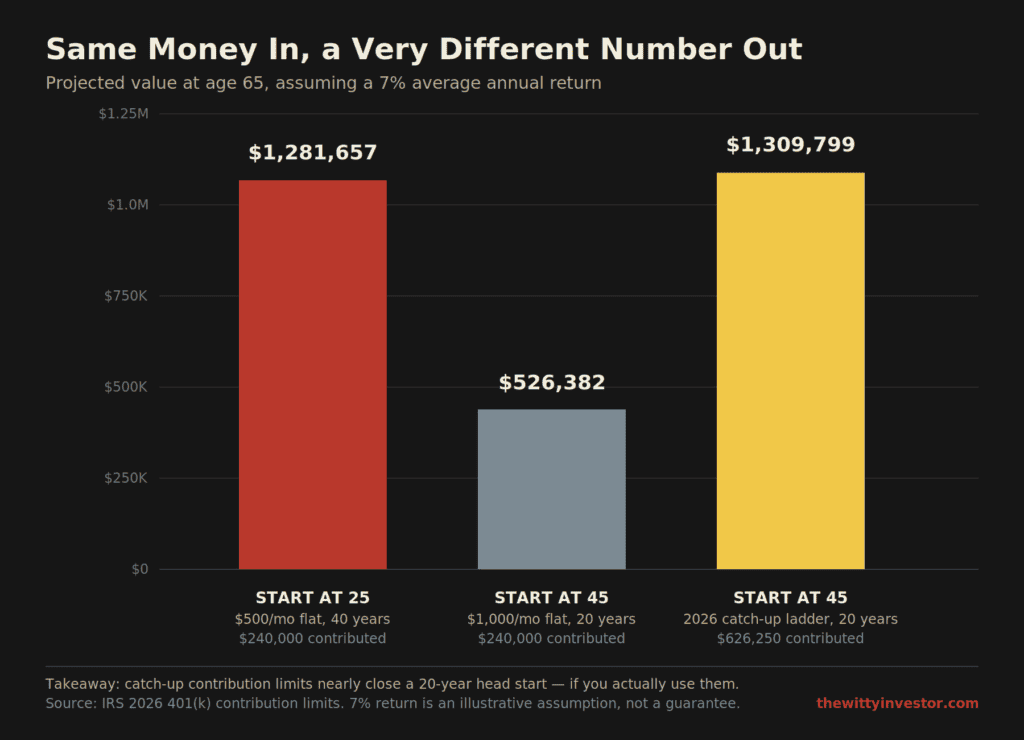
Start with the boring, honest version first — no catch-up contributions, no hero moves, just the raw cost of starting late. Over 20 years of intense outdoor expeditions and financial discipline, I’ve learned that ignoring reality only makes the trail steeper.
Two people each put $1,000 a month into a retirement account and get a 7% average annual return. One starts at 25. One starts at 45. Both stop at 65.
- Start at 25: $240,000 contributed over 40 years yields $1,281,657 at age 65.
- Start at 45: $240,000 contributed over 20 years yields $526,382 at age 65.
Same total dollars out of your pocket. Less than half the result. That’s not a trick, it’s just what 20 fewer years of compounding costs you. Anyone who tells you time doesn’t matter is selling something. For a deeper look into structuring your long-term asset allocation, check out The Witty Investor
.
What Catch-Up Contributions Actually Buy You
Here’s the part the internet skips: the tax code already knows about this problem, and it built you a bigger door. For 2026, the IRS lets you defer up to $24,500 into a 401(k) if you’re under 50. At 50, catch-up contributions kick in (you can review official guidelines via the IRS Retirement Topics Guide
). From 60 through 63, there’s a “super catch-up” provision.
Run the same 45-year-old through that actual ladder — maxing deferrals at each age bracket instead of a flat $1,000 a month — and the picture changes dramatically for your retirement savings at 45:
- Age 45–49:$24,500/year
- Age 50–59: $32,500/year (standard catch-up)
- Age 60–64: $35,750/year (super catch-up)
Total contributed: $626,250. Value at 65: $1,309,799 — slightly ahead of the 25-year-old who started with $500 a month and never touched it again.
Notice what actually closed the gap. It wasn’t a better fund, a hot stock, or someone’s secret system. It was contributing roughly 2.6 times more money out of pocket. Catching up is real. It’s just not free, and nobody selling a course wants to lead with that part.
The Checkpoint at 55, If You Want a Gut Check
If 65 feels too far away to plan around, here’s the same two flat-contribution scenarios at 55, ten years in for the late starter:
- Start at 25, still $500/mo: $606,438 at 55
- Start at 45, $1,000/mo: $177,403 at 55
That gap is why waiting to “get serious later” costs more than it looks like it should. The years right after 45 are doing more heavy lifting than the years right before 65. If you are balancing multiple life priorities or transitioning out of debt, tools like Adventure Wiser
offer perspective on managing sustainable off-grid lifestyle shifts and practical budgeting.
The Levers You Have at 45 That You Didn’t at 25
None of this is a reason to give up, it’s a reason to be honest about which tools you’re actually holding:
- Higher income potential: Most 45-year-olds can put more real dollars to work than they could at 25, even if lifestyle creep makes it feel tight.
- Catch-up contribution room: The government built a bigger container specifically for this situation. Use every dollar of it.
- A clearer target number: At 25 you’re guessing at a retirement forty years away. At 45 you can see the finish line well enough to plan for it instead of vaguely hoping.
- Fewer competing priorities, eventually: Kids grow up, mortgages shrink, and cash that used to go toward childcare becomes available for your future.
The Honest Verdict
Starting at 45 is not the same game as starting at 25. Anyone telling you otherwise is either bad at math or trying to sell you a shortcut. But “not the same” isn’t “hopeless” — it’s a different price.
The price of catching up on your retirement savings at 45 is contributing more, on purpose, using the exact catch-up room the tax code already handed you. That’s the whole trick. There isn’t a second one.