Witty
Realty Income: Witty, Risky, or Just Very Popular at Retirement Parties?
There is a particular kind of stock that shows up in every dividend portfolio the way a folding chair shows up at every family gathering. Nobody is excited about it. Nobody is getting rid of it either.
Realty Income has paid 670 consecutive monthly dividends and raised the payout roughly 135 times across 31 years. It calls itself The Monthly Dividend Company, which it has trademarked, which tells you most of what you need to know about the personality involved.
So the question isn’t whether it pays. It pays. The question is what you’re actually buying at today’s price, and whether the thing people love about it is the same thing they’re quietly expecting it to do.
Those turn out to be two different things.
I read the filings so you don’t have to. You’re welcome. And I’m sorry.
Table of Contents
The numbers that matter
As of early August 2026, drawn from Realty Income’s Q1 2026 supplemental and operating results release. Verify before acting on any of it.
| Metric | Figure |
|---|---|
| Share price | ~$65.50 |
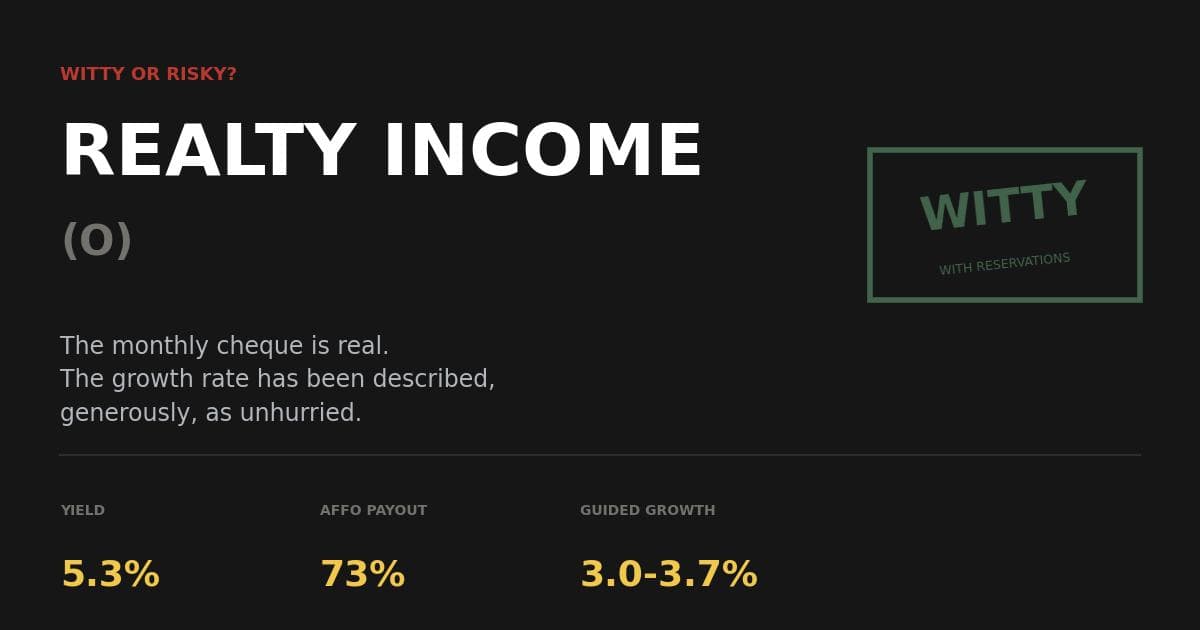
| Dividend yield | ~5.3% |
| 2026 AFFO guidance | $4.41 – $4.44/share |
| AFFO payout ratio | ~73% |
| P/AFFO | ~14.8x |
| Portfolio occupancy | 98.9% |
| Net debt / EBITDA | 5.2x |
| Credit rating | A− |
| Consecutive monthly dividends | 670 |
Note what isn’t on that list: anything resembling growth. We’ll come back to that.
The Real Income Scorecard
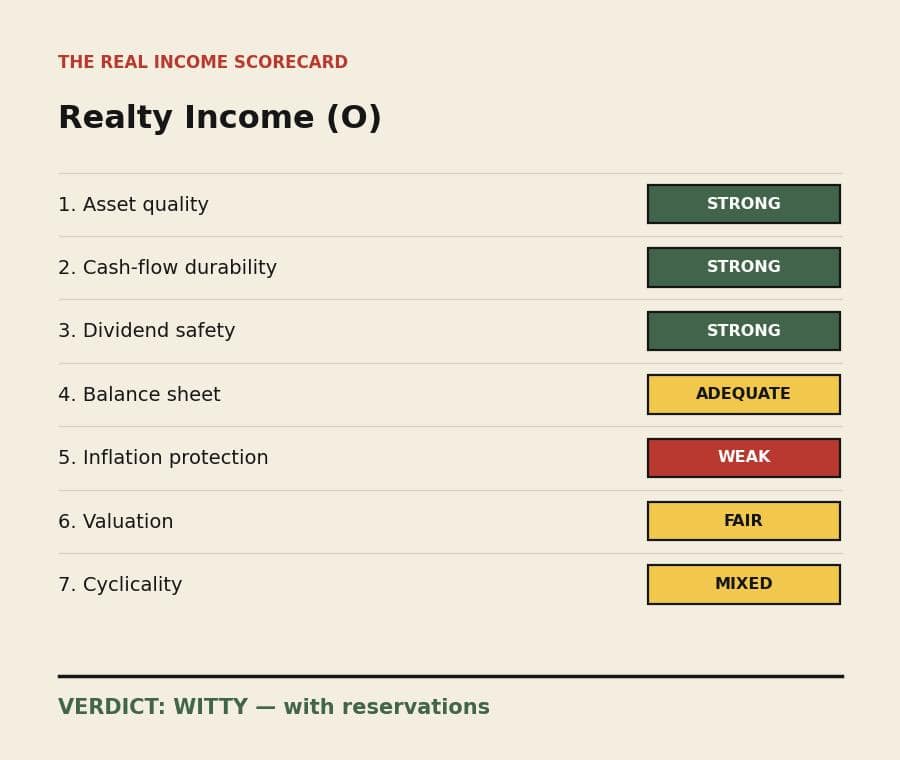
Every company on this site gets the same seven questions. No star ratings pulled from a vibe.
1. Asset quality — what does it actually own?
Single-tenant, freestanding commercial properties on long net leases. Roughly 91% of retail base rent comes from tenants that are non-discretionary, low-price-point, or service-oriented — dollar stores, pharmacies, convenience, quick-service restaurants. The stuff people buy when they are not feeling especially prosperous.
That’s the right kind of retail to own. Occupancy is 98.9%, and it has never dropped below 96% since the 1994 IPO — a run that includes 2008, 2020, and the 2022 rate shock.
Strong. This is the part of the business that earns the reputation.
2. Cash-flow durability — how predictable is the income?
Net lease means the tenant pays taxes, insurance, and maintenance. Realty Income collects rent and, in the ideal case, does very little else. Rent recapture on re-leased space came in at 103.4%, meaning it’s replacing expiring leases at slightly higher rents.
This is the quality I went looking for across the sector in Dividend Defense: Stocks That Survive Market Chaos — the ability to keep paying when the market starts throwing furniture. Realty Income has it.
Strong. The model is boring in the way that a well-built retaining wall is boring.
3. Dividend safety — does the payout survive a bad year?
The AFFO payout ratio sits around 73%. For a net lease REIT that’s comfortable — it leaves roughly a quarter of cash flow as cushion before anything has to give.
Ignore the GAAP payout ratio, which reads north of 260% and means nothing here. REITs carry enormous non-cash depreciation charges against buildings that are not, in fact, crumbling. Anyone quoting that number at you about a REIT is telling you something about themselves, not about the company. It’s the same category of error I picked apart in The Dividend Delusion — using the wrong denominator and drawing a confident conclusion from it.
Strong. The dividend is not the risk.
4. Balance sheet — how much debt is holding this up?
Net debt to EBITDA is 5.2x, improved from 5.4x at the end of 2025. The credit rating is A−.
Here’s the mild reservation: 5.2x is a touch elevated for an A− issuer, and this is a business where the cost of debt directly sets the return on new acquisitions. Realty Income grows by borrowing money, buying buildings, and pocketing the spread between the two. When borrowing costs rise, that spread narrows, and the growth engine doesn’t break so much as quietly downshift.
Adequate. Not alarming. Not nothing.
5. Inflation protection — can the rent adjust?
And here we arrive at the part nobody puts in the thumbnail.
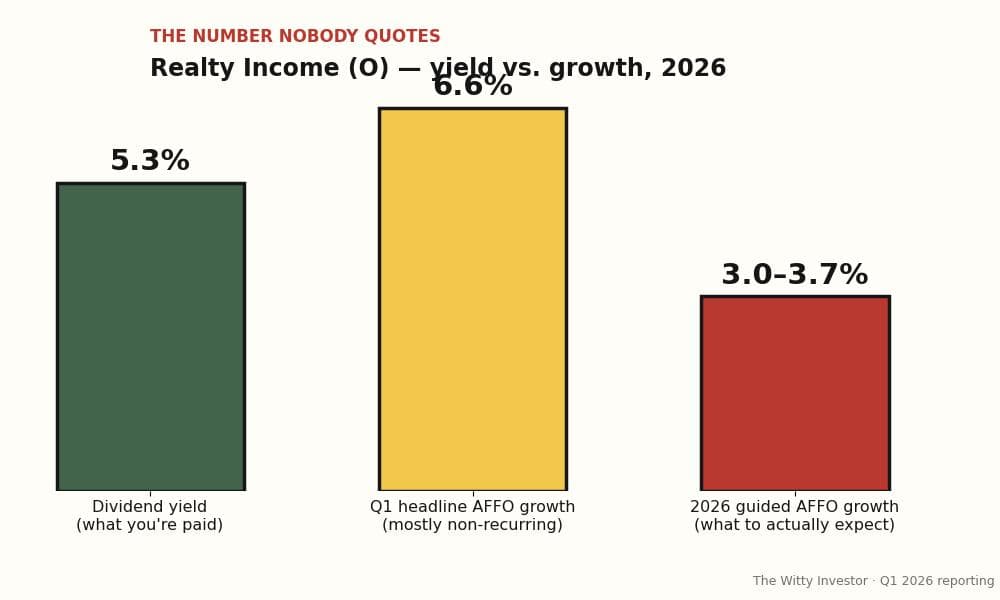
Net lease escalators are famously modest — typically around 1% a year. Same-store rent growth has been lagging inflation. Management guides to AFFO per share growth of 3.0% to 3.7% for 2026.
Read that again slowly, because it’s the single most important number in this entire piece. Not the 5.3% yield. That one.
Weak. This is the structural cost of the model, and it is permanent.
WITTY TAKE: A 5.3% yield growing at 3% is a fundamentally different asset from a 3% yield growing at 10%. Both are fine. They are not the same thing, and the person who owns one while expecting the other is going to be disappointed on a schedule.
6. Valuation — is the current yield worth the risk?
About 14.8x 2026 AFFO guidance. The average analyst price target is roughly $67.21, which implies something in the neighbourhood of 3% price upside.
Three percent. From the analysts. Who are, as a professional community, not known for their pessimism.
Add the 5.3% yield and you land at a total return expectation somewhere around 8% — assuming the multiple doesn’t move, which is a considerable assumption for a rate-sensitive asset in 2026. And before you bank that 8%, run it through the Fee Drag Calculator, because the number you keep is not the number you earn.
Fair. Not cheap. Not expensive. Priced approximately correctly, which is the least exciting conclusion available and probably the right one.
7. Cyclicality — what happens when things go wrong?
Two different answers, depending on what goes wrong.
Recession: the portfolio holds up. Dollar stores and pharmacies do fine when people are anxious. This is genuinely defensive.
Rates rise: the stock gets hit twice — once because REIT valuations compress against higher risk-free yields, and once because acquisition spreads narrow. That’s not a credit problem. It’s a price problem. But if you’re within a few years of needing the capital rather than the income, the distinction may feel academic — which is the argument for holding a proper cash buffer so you’re never a forced seller into a rate print.
Mixed.
What could go wrong
The mandatory section, because a verdict without a bear case is a press release.
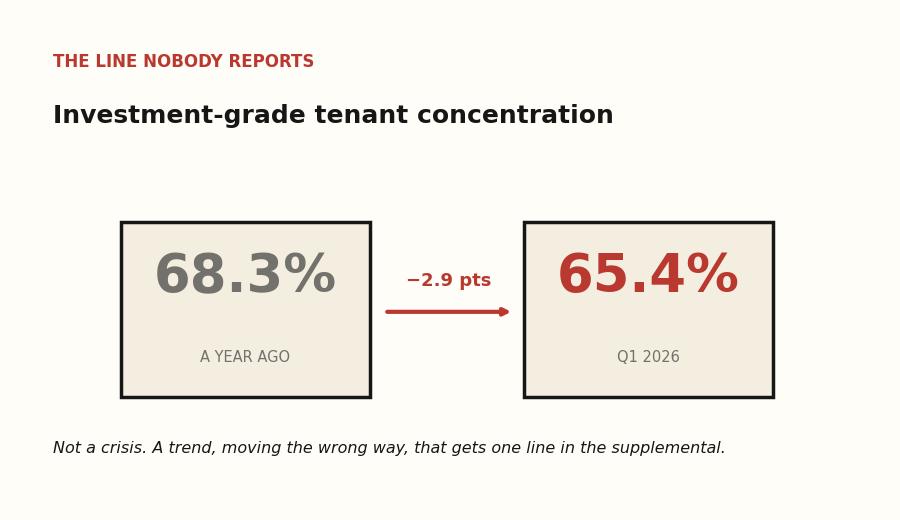
The quiet one — tenant credit is drifting. Investment-grade tenant concentration slipped to 65.4% from 68.3% a year ago. That is not a crisis. It is a trend, moving in the wrong direction, and it’s the sort of thing that gets a single line in the supplemental and no mention anywhere else.
The one that requires reading the footnotes. Q1 2026 AFFO per share rose 6.6% year over year to $1.13, which sounds excellent. Most of that increase came from non-recurring items. Underlying organic growth was considerably more modest. If you saw the 6.6% headline and updated your expectations upward, update them back.
Concentration in structurally challenged retail. Dollar General and Walgreens are large tenants in a portfolio like this, and both operate in categories facing real secular pressure. Net leases are long and the rent is contractual — but a tenant that closes stores eventually renegotiates, and 103.4% recapture is a current figure, not a promise. The company’s own proxy statement and SEC filings are where the tenant tables actually live.
Size. Realty Income deployed roughly $2.8 billion in a single quarter. Moving a portfolio this large requires an enormous volume of acquisitions just to shift the per-share numbers at all. Scale is a moat and an anchor simultaneously.
Rates. Covered above, but it bears repeating, because it’s the variable that actually determines your entry price.
FINE PRINT NOBODY READS: All figures here reflect Q1 2026 reporting and guidance issued at that time. REIT metrics move with every quarter and every rate decision. If you’re reading this more than a quarter after publication, the numbers are decoration.
The bottom line
Verdict: WITTY — with reservations.
Realty Income does exactly what it claims to do. It collects rent from unglamorous buildings, mails you a cheque every month, and has done so through three separate crises without interruption. The dividend is well covered, the balance sheet is investment grade, the occupancy is close to perfect. On its own terms, it works.
The reservation isn’t about the company. It’s about what people expect from it.
At roughly 15x AFFO with 3% growth guidance and 3% analyst upside, this is an income instrument. Not an income instrument that also compounds handsomely — an income instrument. If you own it for the monthly cheque and you’re comfortable with a total return in the high single digits, you own the right thing for the right reason.
If you own it because someone described it as a dividend growth stock, you have accidentally bought a bond with a stock’s volatility, and the next few years may involve some feelings.
Suits: investors who want dependable monthly income and have made peace with modest capital appreciation.
Doesn’t suit: anyone under forty with a long runway who needs the money to actually grow, or anyone who’d panic when the price falls 15% on a rate print while the dividend carries on untouched. If that’s you, a diversified basket like the ones in 6 Dividend ETFs That Pay You to Stay Put spreads the single-name risk without giving up the income.
The main risk: not a dividend cut. Rate-driven multiple compression, and the slow drift in tenant credit quality that nobody’s putting in a headline.
It is very popular at retirement parties. That turns out to be a reasonable description of both the stock and the correct owner.
More verdicts in Witty or Risky? · Dividend safety cases in Dividend Court · Or find out what your portfolio is actually returning after fees with the B.S. Detector.
Disclosure, up front where it belongs: I own shares of Realty Income. That should make you slightly more suspicious of what follows, not less — which is precisely why it’s here at the top rather than in the small print at the bottom. Read the bear case twice.
Nothing here is financial advice. I’m an independent investor sharing my own research — not a licensed advisor, and not your fiduciary. I don’t know your situation, your timeline, or your risk tolerance. Do your own research, read the actual filing, and consider talking to someone legally obligated to care about your outcome.
Witty
A 5.3% yield growing at 3% is a fundamentally different asset from a 3% yield growing at 10%. Both are fine. They are not the same thing.