M1 Finance vs. Betterment is really a question about who makes the decisions in your portfolio. Here is what each one costs at every balance, and who should pick which.
You have a few thousand dollars sitting in a savings account, doing an impression of a very polite doormat. You have decided, finally, to invest it. You have narrowed it to two apps that every personal finance blog seems to agree on. Both promise automation. Both promise low fees. Both have very calm color schemes.
They are not the same product, and the difference is not the one their marketing argues about. One wants you to make the decisions. The other wants you to stop making them. Pick the wrong one for your temperament and you will either be bored into tinkering or annoyed into quitting.
The 30-Second Answer
Pick Betterment if you want someone else to build and run the portfolio, you want tax-loss harvesting in a taxable account, or your balance is small but you can automate $200 a month. Pick M1 Finance if you want to choose every holding yourself and you have, or will soon have, $10,000 on the platform, where M1’s fee drops to zero and Betterment’s 0.25% keeps running forever.
Everything below is the reasoning, the fine print, and the one situation where the usual advice gets it backwards.
M1 Finance vs. Betterment: What These Things Actually Are
M1 Finance is a brokerage built around “Pies.” You choose stocks and ETFs, assign each a target percentage, and M1 steers new deposits toward whatever has drifted below target. It is automation for people who want to do the picking. I covered it in depth in my full M1 Finance review.
Betterment is a robo-advisor. You answer questions about your goals and risk tolerance, and Betterment builds a diversified ETF portfolio, rebalances it, and harvests tax losses in taxable accounts. It is automation for people who would rather not pick. It has since added a self-directed investing account with no management fee, which blurs the line a little, but the core product is still managed.
So the comparison is not app versus app. It is do-it-yourself-with-a-robot versus let-the-robot-do-it.
The Core Difference in M1 Finance vs. Betterment: Who Does the Deciding
That one difference drives the fee structure, and the fee structure is where most people get the math wrong.
M1 charges a $3 monthly platform fee that disappears completely once your total M1 assets reach $10,000 on at least one day in a billing cycle. It charges nothing for advice because it gives none on the investing side; you are the advisor.
Betterment charges for management. Its current pricing is $5 a month for balances under $24,000, switching to 0.25% a year once you either reach $24,000 or set up recurring deposits of $200 or more a month. That 0.25% never goes away. It just gets bigger as you do.
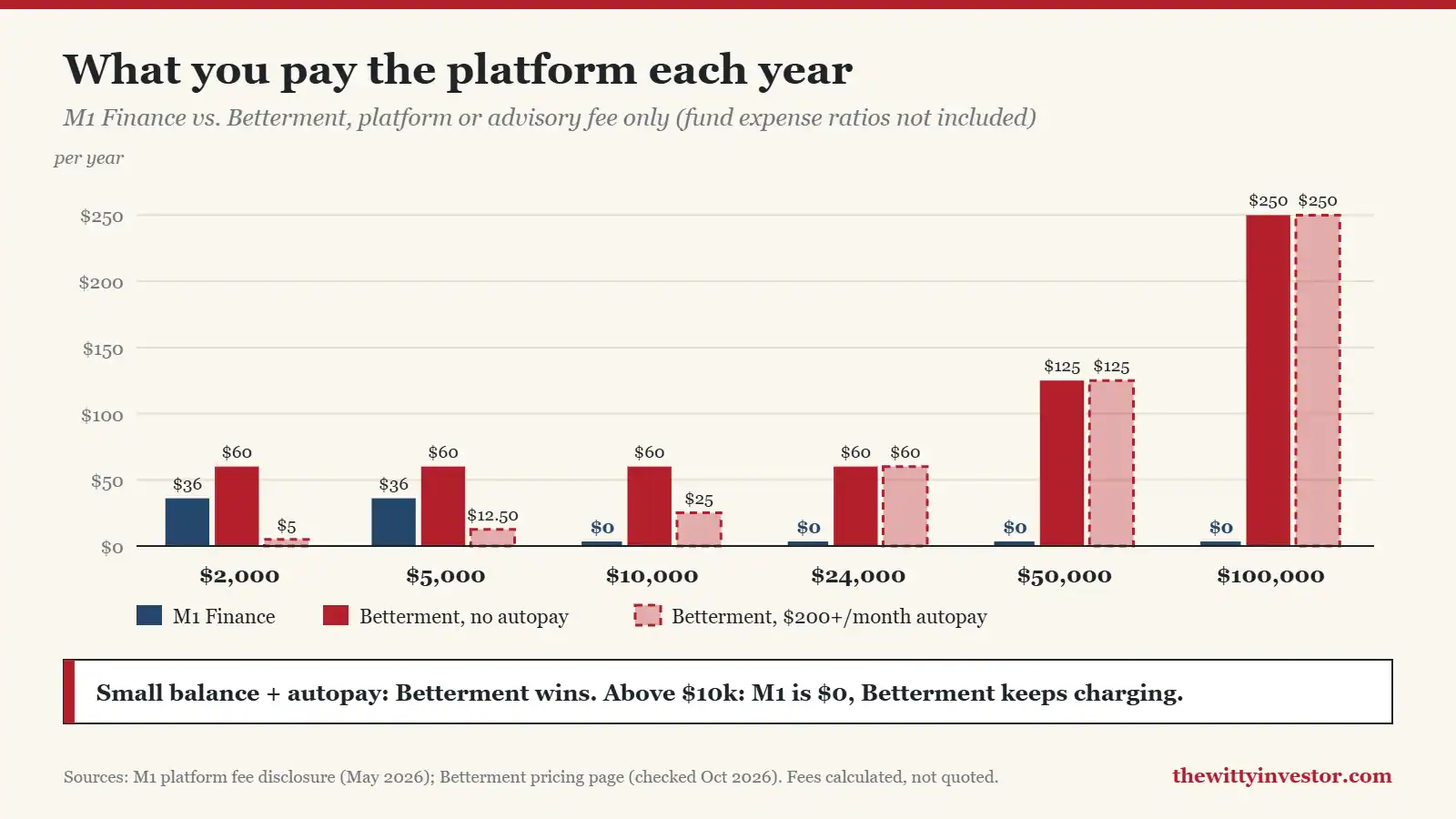
Run the numbers and it splits cleanly. At $5,000 with no autopay, M1 costs $36 a year and Betterment costs $60. At $5,000 with $200 a month going in, Betterment drops to about $12.50 and beats M1. At $50,000, M1 costs nothing and Betterment costs $125. At $100,000 it is $250 a year, every year. If you want to see what a quarter-point does over decades, the fee drag calculator will show you, and it is not a cheerful afternoon.
Whether that $250 is a fair price depends on whether you would actually do the work Betterment does for it. Be honest with yourself there. Most people overestimate their future discipline the same way they overestimate how often they will use a gym membership.
Head-to-Head: Fees, Features and Fine Print
| M1 Finance | Betterment | |
|---|---|---|
| Model | You pick holdings; M1 automates | Betterment builds and manages the portfolio |
| Platform / advisory fee | $3/month under $10,000; $0 at $10,000+ | $5/month under $24,000; 0.25%/year at $24,000+ or with $200+/month autopay |
| Human advice | None (free AI advisor, M1 Advisor) | Premium plan, 0.65%/year, $100,000 minimum |
| Tax-loss harvesting | No | Yes, in taxable accounts |
| Trading | Batched trade windows, 9:30 a.m. ET | Automated; separate self-directed account available |
| Fractional shares | Yes | Yes |
| Cash account APY | 3.35% (Sept 2026) | 3.50% Cash Reserve (Sept 21, 2026) |
| Cash FDIC coverage | Up to $4.75M via partner banks | Up to $4M ($8M joint) via program banks |
| Margin borrowing | Yes, from $2,000 invested | Not part of the core managed product |
| Outbound transfer fee | $100 per account, plus $100 to close an IRA | $75 per account |
| Best for | Hands-on long-term investors with $10k+ | Hands-off investors, especially in taxable accounts |
Prices and rates checked October 2026. Cash rates move with the Fed; check both sites before you decide.
Where I’d Push Back on the Hype
On Betterment
Tax-loss harvesting is real, but it is not free money. It defers taxes rather than erasing them, and it only matters in a taxable account. In an IRA it does nothing, and you are paying 0.25% for a robot to rebalance a portfolio that does not need much rebalancing. Betterment’s own pricing page says most customers using the feature had their fee covered by likely tax savings, and that may well be true for them. It will not be true for everyone, and it will not be true for your Roth.
Also worth knowing: in January 2026 Betterment had a security incident in which an attacker social-engineered an employee and reached marketing and operations tools. Betterment says the exposed data was mostly names and email addresses, that no customer accounts or passwords were compromised, and that it reimbursed people who lost money to a fraudulent crypto message sent in its name. That is a reasonably well-handled bad day. It is also a good reason to never trust an email that asks you to move money.
On M1 Finance
“Free” above $10,000 is accurate, and it is still not the whole story. M1 has no tax-loss harvesting, no human advisor, and a one-click Rebalance button that sells things and creates taxable gains if you use it carelessly. You are getting a tool, not a manager. Tools are only as good as the person holding them, which, in this case, is you, at 11 p.m., after reading a headline. If that sounds familiar, read up on why investors panic-sell before you trust yourself with that button.
The trade windows also cut both ways. Orders run at 9:30 a.m. Eastern, with a 3:00 p.m. window that M1 added in 2026 and now offers to every account (one window a day under $25,000, both at $25,000 or more). That is a fine speed bump for long-term investors and a genuine annoyance for anyone who likes to know exactly what price they paid.
M1 Finance vs. Betterment by Situation
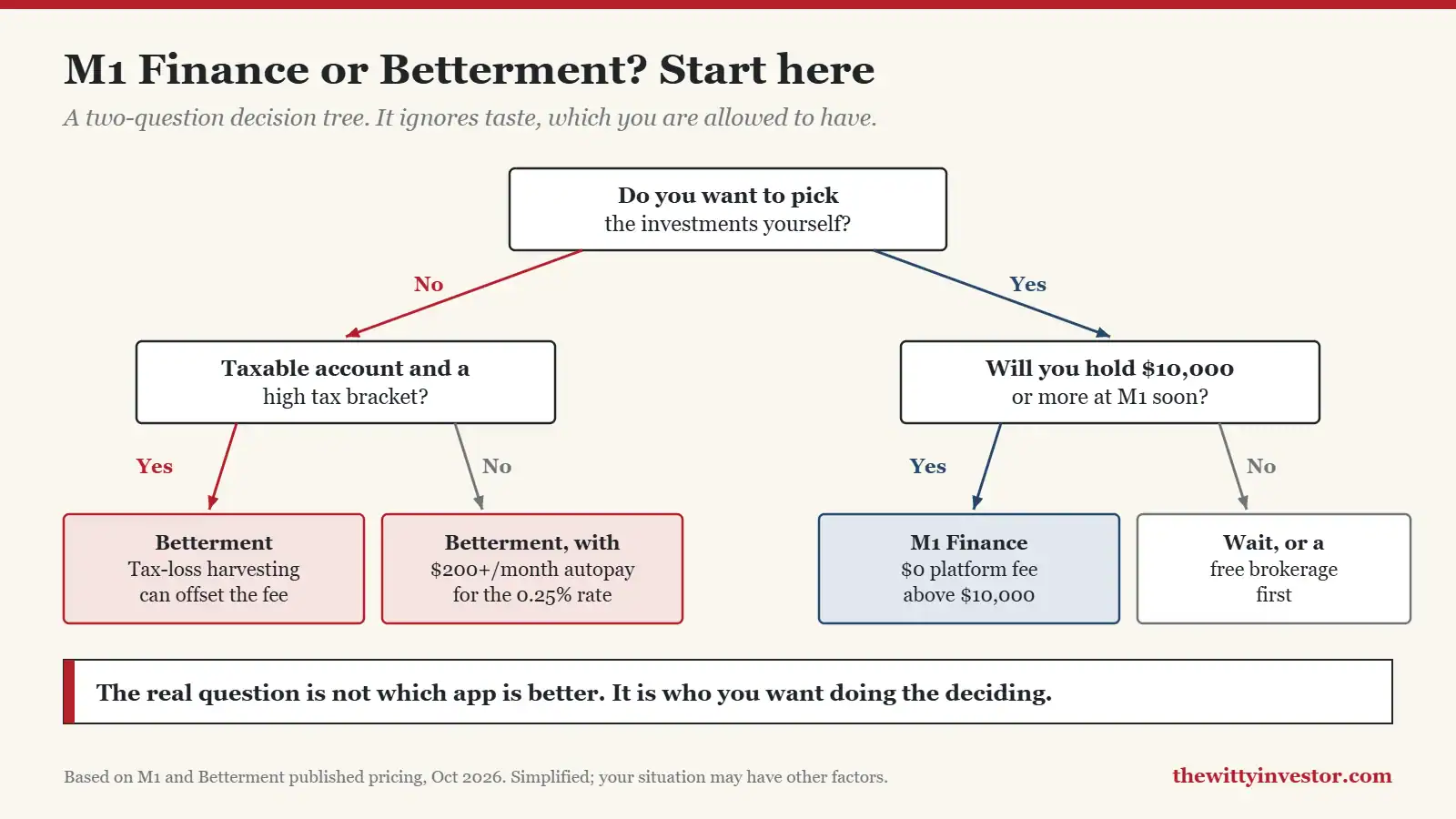
You are just starting with under $5,000 and can automate $200 a month. Here is the counterintuitive one: Betterment. The usual advice says M1 is cheaper, but M1’s $36 a year on a $3,000 balance is 1.2%, while Betterment with autopay is 0.25%, or $7.50. The cheap platform is only cheap once you are big enough to qualify.
You have $10,000 or more and want control. M1, and it is not close on fees. You pay nothing to the platform and keep every dollar of a 0.25% that compounds in your favor for decades.
You have a large taxable account and a high tax bracket. Betterment’s tax-loss harvesting has the most to work with here. This is the strongest case for paying the fee.
You are a late starter, 45 or older, catching up fast. Your bigger risk is not fees; it is inconsistency. Pick whichever one you will actually keep funding. The real math on starting retirement savings at 45 shows why the contribution rate matters more than a quarter-point either way.
You want to buy individual dividend stocks. M1. Betterment’s managed portfolios are diversified ETF baskets, and its self-directed account is a separate thing. If dividends are the plan, also look at the best brokerages for dividend investing.
What Neither One Is
- Neither is a trading platform. If you want options, limit orders or minute-by-minute execution, you are in the wrong building.
- Neither offers mutual funds you can buy into a managed or Pie portfolio.
- Neither replaces an emergency fund. Both offer good cash accounts, but a cash account sitting next to your investments is very easy to raid. Keep your cash buffer deliberately separate.
- Neither protects you from the market going down. SIPC covers a broker failing, not your portfolio falling. You can check either firm on FINRA BrokerCheck.
If You’re Opening an Account
Both are free to open. The costs show up later, so here is the full list as of October 2026:
- M1: $3/month until total M1 assets hit $10,000 (90-day grace period for new users). Cash account pays 3.35% APY with a $100 minimum to earn the stated rate. Leaving costs $100 per account, plus $100 to close an IRA.
- Betterment: $5/month until $24,000 or $200+/month autopay, then 0.25%. Premium with human CFPs is 0.65% and needs $100,000. Leaving costs $75 per account.
- Both: fractional shares are sold, not transferred, when you leave. In a taxable account that sale can create a tax bill you did not plan for.
Then do the boring thing that saves the most money: open the pricing page for each, plug in your actual balance and your actual monthly deposit, and see which number is smaller. It takes five minutes and nobody does it.
Frequently Asked Questions
Is M1 Finance or Betterment better for beginners?
Betterment, for most beginners. It builds the portfolio for you, and with $200 a month on autopay its fee on a small balance is lower than M1’s flat $3 a month. M1 suits beginners who already know what they want to own.
Is M1 Finance cheaper than Betterment?
Above $10,000, yes: M1 charges no platform fee while Betterment charges 0.25% a year. Below that, it depends on deposits. Betterment with $200+ a month of autopay is usually cheaper on small balances.
Does M1 Finance have tax-loss harvesting like Betterment?
No. M1 reduces selling by steering new deposits into underweight slices, but it does not harvest losses. Betterment harvests losses automatically in taxable accounts.
Can I move from Betterment to M1 Finance?
Yes, by ACATS transfer started from M1’s side. Betterment charges $75 per account, and fractional shares are sold and sent as cash, which can be taxable in a taxable account.
Is Betterment safe after the 2026 data breach?
Betterment says no customer accounts, passwords or login information were compromised in the January 2026 incident, and accounts remain SIPC-protected. Treat any email asking you to move money as suspicious, from any company.
Which pays more on cash, M1 or Betterment?
As of late September 2026, Betterment’s Cash Reserve paid 3.50% APY and M1’s cash account paid 3.35%. Both rates are variable and both run promotions, so check before moving money for a few basis points.
The Bottom Line on M1 Finance vs. Betterment
The honest answer to M1 Finance versus Betterment is that you are choosing a relationship with your own decisions. If you want to make them and you have $10,000 to work with, M1 does the mechanical work for free. If you would rather not make them, or you are small and can automate $200 a month, Betterment is worth its fee, especially in a taxable account.
So here is the assignment: write down your balance and what you can deposit every month, then check both pricing pages against those two numbers. Then pick one, set up the autopay today, and stop reading comparison articles, including this one. If you want the next one anyway, it is in The Verdict newsletter.
Reviews on The Witty Investor are built from fee schedules, disclosures and math, labeled for what they are. No platform paid for placement, and nothing here was tested with real money unless it says so. More about how I review.