
Most advice on how to spend less money starts with a list of things to quit. This one starts with a better question, and keeps the coffee.
I want a less expensive life.
I still want coffee I enjoy. A comfortable home. A few hobbies. The occasional purchase that doesn’t require a committee meeting with my checking account.
What I want less of is the stuff that runs on autopilot: bills that arrive whether or not I noticed them, and things that need replacing, charging, upgrading, or their own monthly subscription. So I’m spending the next month finding out which expenses earn their place and which ones I’m paying for mostly because I never stopped to ask.
This post is the written version of Week 1 of that experiment. If you’d rather watch than read, the video is right here:
Watch: I Want a Less Expensive Life (Not a Miserable One)
What Is Spending Less Without Being Miserable?
It’s frugal living with one rule attached: you’re allowed to keep things you actually like.
Most money advice treats every dollar out the door as a small moral failure. That works for about three weeks, right up until you’re sitting in a quiet house eating plain rice and resenting a spreadsheet. Then the old spending comes back, usually with friends.
The version I’m testing is different. Instead of cutting first, it asks what you want your money to do, then checks each expense against that. Some things stay. Some shrink. Some go on pause. Nothing gets cut just to prove a point.
Reasons You Need to Know How to Spend Less Money This Way
Spending creeps in quietly, and the numbers say most of us don’t see it:
- We underestimate recurring costs badly. In a C+R Research survey, people guessed they spent about $86 a month on subscriptions. When they itemized them, the real figure averaged $219, roughly $133 more than they thought.
- Some of it buys nothing at all. CNET’s 2026 subscription report put the average spent on forgotten or unused subscriptions at about $252 a year, up from $204 the year before.
- Autopay hides it. The same C+R survey found that 86% of people had some or all of their subscriptions on autopay, and 42% had forgotten about one they no longer used.
- Owning things costs more than buying them. Supplies, maintenance, storage and replacements never show up on the original receipt.
None of that requires a dramatic lifestyle overhaul to fix. It requires looking. The method below is how I’m doing the looking.
Step-by-Step Instructions to Spend Less Money Without Hating It
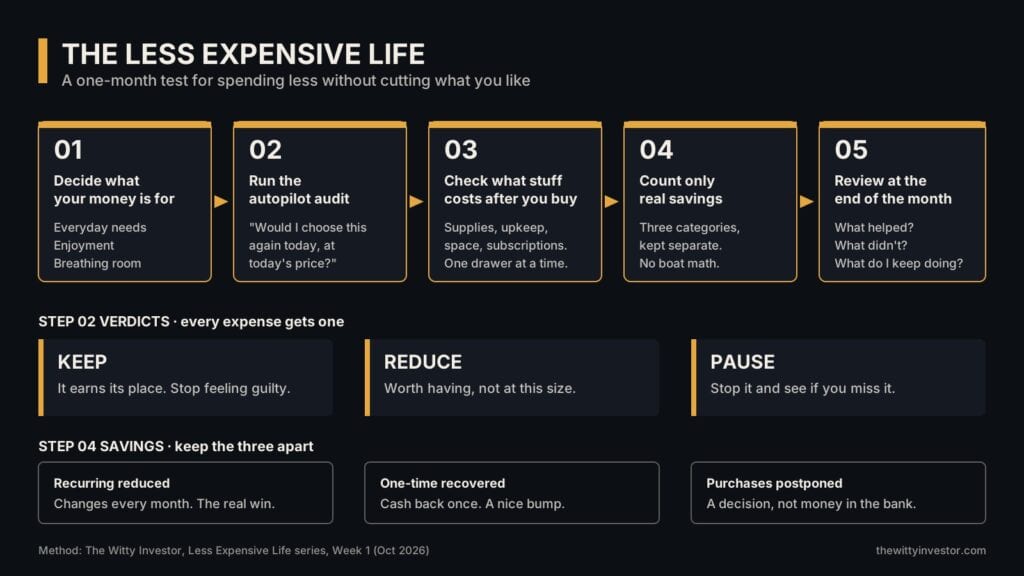
Here’s the whole process. It takes a month, and most of the work is noticing, not sacrificing.
- Decide what your money is for. Three buckets before you cut anything.
- Run the autopilot audit. Ask every recurring expense one question.
- Check what your stuff costs after you buy it. One drawer at a time.
- Count only real savings. Three categories, kept separate.
- Review at the end of the month. Keep what worked, drop what didn’t.
The order matters. Step 1 is what keeps the rest from turning into a guilt exercise.
Step 1: Decide What Your Money Is For
Before crossing anything out, I wrote one question at the top of a notebook page: What do I want my money to do for me?
Underneath it, three buckets:
- Everyday needs. Housing, food, transportation, and all the ordinary things that keep a household running.
- Enjoyment. Yes, on purpose. A budget with zero joy in it is a budget you’ll quit.
- Breathing room. Money available when something breaks. The ability to make a decision without immediately wondering which bill it will interfere with.
Breathing room is the bucket most people skip, and it’s the one I care about most. It’s not a savings goal with a number attached. It’s the absence of that low-grade worry that comes with every unexpected expense.
If you’re doing this in your forties, fifties or later, there’s no entrance exam. (If retirement is the worry underneath all this, here’s the real math on starting retirement savings at 45.) You don’t need a perfect budget, and you don’t need a story about investing your lunch money in middle school. Start with the decisions in front of you now.
Step 2: Run the Autopilot Audit
The first place to look is spending that happens without a decision.
Subscriptions are the obvious example, but autopilot goes further. The same items landing in the grocery cart every week. The upgrade that suddenly feels necessary because a newer model exists. The small convenience purchases that quietly became a routine.
None of these is automatically bad. A service you use every day may be worth every dollar. Something that saves you time during a hard week may be doing exactly its job.
So the test is one question: Would I choose this again today, at today’s price?
That seems like a fair thing to ask anything that’s allowed to withdraw money from my account. Then every expense gets one of three verdicts:
- Keep. It earns its place. Leave it alone and stop feeling guilty about it.
- Reduce. Worth having, but not at this size. Downgrade the plan, buy less often, share it.
- Pause. Not worth it right now. Cancel or suspend it and see if you miss it.
I’m deliberately including things I keep. Otherwise this becomes a project where I slowly eliminate every source of enjoyment until my only hobby is checking the electric meter.
To find app-store subscriptions fast, check the subscription list in your phone settings. Apple has a page on canceling subscriptions billed through your Apple Account, and Google Play has one for pausing or canceling a Play subscription. For everything else, scroll back through two or three months of bank and card statements. Anything that appears every month goes on the list.

Step 3: Check What Your Stuff Costs After You Buy It
The receipt is the cheapest moment of owning most things.
After that come the supplies, the maintenance, the subscription some devices now expect, the space it takes up, and occasionally the moment it falls on you when you open a cupboard. Owning things can be useful and enjoyable. But the price tag doesn’t capture the whole commitment.
This is where practical minimalism earns its keep. I’m not interested in owning 47 things for the aesthetic. The practical question is simpler: would having a little less make everyday life easier? Less time managing things. Fewer duplicates bought because I couldn’t find the one I already own.
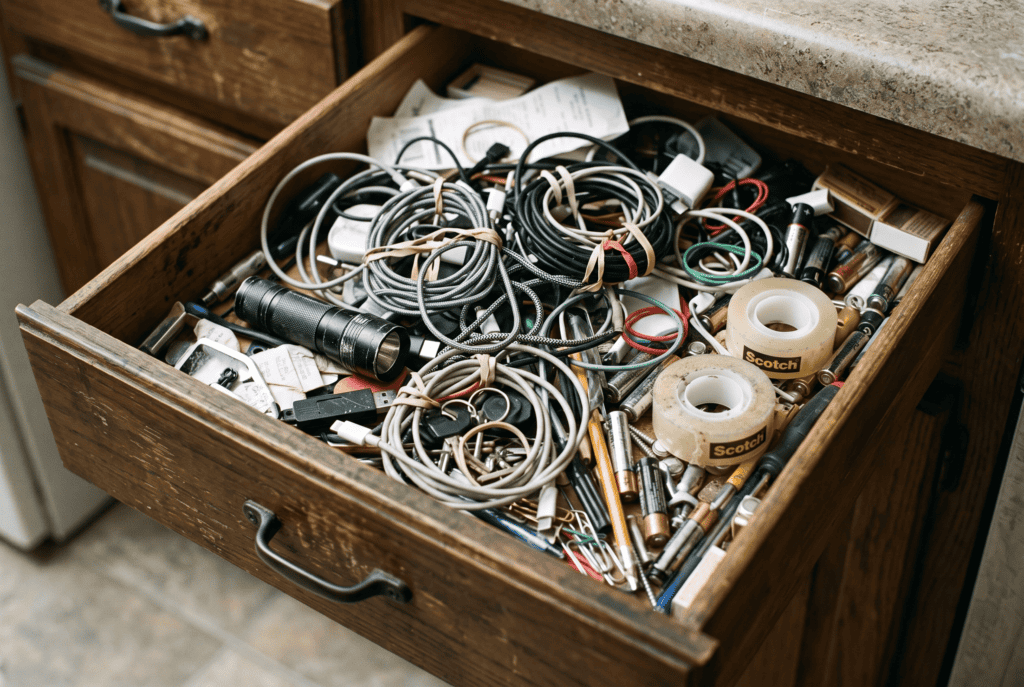
Start small. One drawer, one shelf, or one category. Ask of each item: does this still cost me money or effort, and is it worth that?
And no, you don’t need to buy a matching set of storage containers before you’re allowed to begin. That’s a suspiciously expensive first step toward owning less.
Step 4: Count Only Real Savings
This is the step that keeps the whole thing honest.
If you cut an expense, notice where that money goes. It’s very possible to cancel one thing, spend the same amount somewhere else, and feel exactly as stretched as before.
It’s also easy to fool yourself about what counts as “saved.” Canceling a monthly bill is not the same as selling something once. And deciding not to buy something isn’t savings at all if you were never really going to buy it. By that logic, I saved an enormous amount this morning by not purchasing a boat. The numbers look terrific. My checking account remains unimpressed.
So I track three categories, separately:
| Category | What counts | Example |
|---|---|---|
| Recurring reduced | A monthly or yearly bill that is now smaller or gone | Dropping to a cheaper phone plan |
| One-time recovered | Cash you actually got back once | Selling a tool you haven’t used in two years |
| Purchases postponed | Something you genuinely planned to buy and chose to wait on | Holding off on replacing a working laptop |
Only the first category changes your month-to-month life. The second is a nice bump. The third is a decision, not money in the bank. Keep them apart and you’ll know what actually changed. Then decide on purpose where the freed-up money goes, so it lands in breathing room instead of evaporating.

Step 5: Review at the End of the Month
At the end of the month, answer three questions:
- What helped?
- What didn’t?
- What will I keep doing?
I’m not setting a savings target before I’ve seen the evidence. If a change saves a small amount and is easy to maintain, that’s useful. If it saves nothing, or makes daily life harder for no good reason, that’s worth knowing too. Bring back anything you genuinely missed. That’s not failure. That’s the test working.
Key Considerations for Successfully Spending Less
Don’t cut and replace. The most common way savings vanish is substitution: drop the streaming service, start renting movies. Track where the money goes, not just what you canceled.
Watch for the “investment” purchase. Plenty of people start spending less by buying something: an organizer, an app, a course, a better water bottle. Ask whether the tool solves a problem you actually have, or whether it’s just a more respectable way to shop.
Expect it to feel boring. The real wins here are small and repeatable. A $12 monthly cut you keep for years beats a dramatic purge you abandon in March.
Taking It to the Next Level: Make Breathing Room Automatic
Once you know which expenses you’re keeping, give the freed-up money a job before it gets absorbed. Move the amount of each recurring cut into a separate savings account the same week the cut happens. If you want a structure for that account, here is a three-tier cash buffer that separates true emergencies from planned repairs. That’s when breathing room stops being a feeling and becomes a balance you can see.
Alternatives to This Approach
- The no-spend month. Buy only essentials for 30 days. It works well as a reset and badly as a lifestyle, because it treats every purchase the same.
- A zero-based budget. Every dollar gets assigned a job before the month starts. It’s precise and effective, but it takes more time than most people will keep giving it.
- The cut-everything purge. Cancel it all and add back only what you miss. Fast, satisfying for a week, and the most likely to rebound.
The Keep/Reduce/Pause approach sits between them. It’s less strict than a no-spend month and less work than a zero-based budget. It’s also the one you’re most likely to still be doing in six months.
Frequently Asked Questions
How do I start spending less money if I don’t have a budget? You don’t need one to begin. Pick one expense you’ve been meaning to look at, find out what it actually costs, and ask whether you’d choose it again today. One decision is a start.
What’s the fastest way to find subscriptions I forgot about? Check the subscription list in your phone’s app store settings, then scan two or three months of bank and card statements for anything that repeats. Those two places catch most of them.
Is frugal living the same as being cheap? No. Cheap means always choosing the lowest price. Frugal means spending deliberately, which sometimes means paying more for something that lasts or that you genuinely enjoy.
How much can I save by cutting subscriptions? It varies a lot. Surveys put average spending on unused subscriptions at a few hundred dollars a year, but your number depends entirely on what’s on your list.
Does not buying something count as saving money? Only if you were really going to buy it. Track postponed purchases separately from cut bills so your “savings” reflect money that actually stayed in your account.
Is it too late to fix my spending in my 40s or 50s? No. Spending habits can change at any age, and the decisions in front of you now matter more than the ones behind you. The Late Start section covers the money side of starting later.
Wrapping Up: How to Spend Less Money and Still Like Your Life
I’m one week into this, so there are no results to brag about yet. That’s on purpose. Weeks 2 through 4 each take one part of the method and put it to the test on real expenses, and Week 5 reports what actually changed, including what didn’t work.
Here’s your assignment, and it takes ten minutes: pick one expense you’ve been meaning to look at. Find out what it actually costs per year, not per month. Ask whether you’d choose it again today. Then write down Keep, Reduce or Pause.
You don’t have to overhaul your entire life this afternoon. One decision is enough to start.
This is a five-week experiment run in public. Results get posted as they happen, the boring ones included. Follow along on the channel.