I use Morningstar. The free version. Mostly for two things: fund star ratings and stock fair value estimates. And Morningstar would very much like me to upgrade to Morningstar Investor for $249 a year. It is more polite about it than Seeking Alpha, but it is asking.
So I did what I always do before handing a company my credit card. I read the terms, the help pages and the methodology documents, which is exactly as thrilling as it sounds. This review is what $249 actually buys, why I trust Morningstar more than almost anyone else in this business, and why I still have not paid them a dime.
How I reviewed it: I use Morningstar’s free side for fund ratings and fair value estimates. I have not paid for Morningstar Investor, so everything about the paid plan comes from Morningstar’s own pricing page, terms of use and methodology, checked in November 2026. No affiliate links. How I review.
Morningstar Investor Review: The Verdict Up Front
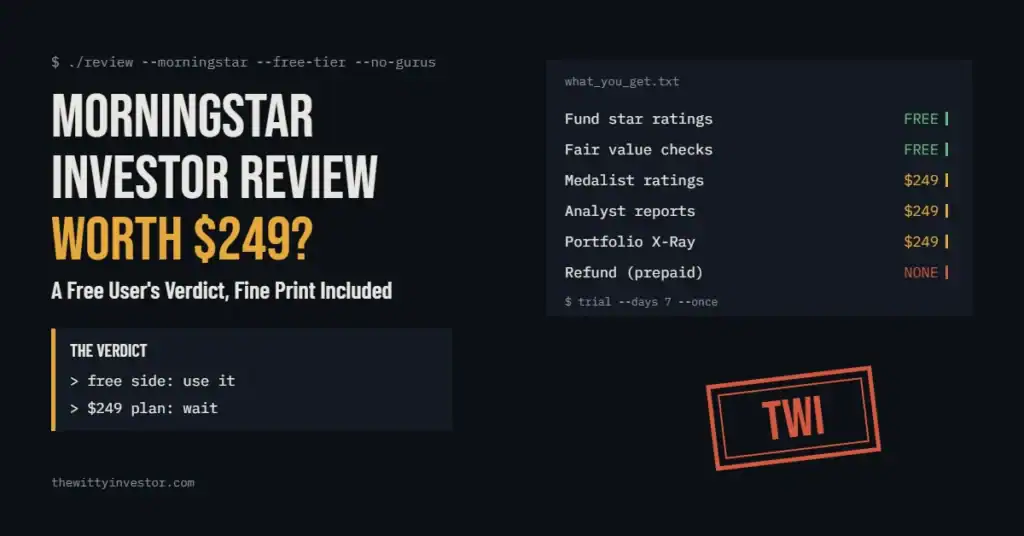
USE the free side. WAIT on the subscription. Morningstar is the most trustworthy ratings shop in retail investing, and that is the whole reason I use it. But for a buy-and-hold investor, the parts I lean on most are already visible for free. The $249 earns its keep if you own a pile of funds and will actually run Portfolio X-Ray on them, or if you want the full analyst write-up behind every fair value estimate. If you mostly want a quick, honest second opinion on a fund or a stock, keep your money and buy another share.
What Morningstar Actually Is
Morningstar is an investment research company that has been rating mutual funds since the 1980s. It does not sell you stocks, manage your money on this site or take a cut of your trades. It sells opinions, data and tools. That business model matters, and I will come back to it.
You have almost certainly seen its work even if you have never visited the site. When a fund company brags about a “5-star fund” in an ad, those stars are Morningstar’s. Fund companies print them on everything. They would print them on the coffee cups if the lawyers let them.
Morningstar Investor is the paid plan for individual investors. It replaced the old Morningstar Premium in June 2022, per Morningstar’s own terms of use.
What I Use: Fund Ratings and Fair Value Estimates
Here is the part most Morningstar reviews skip, because most Morningstar reviews would like you to click the trial button.
Fund Star Ratings
The Morningstar Rating for funds grades a fund’s past performance against similar funds, after adjusting for risk and fees. It is graded on a curve. In every category, the top 10% get five stars, the next 22.5% get four, the middle 35% get three, the next 22.5% get two, and the bottom 10% get one. A fund needs at least three years of history to get rated at all.
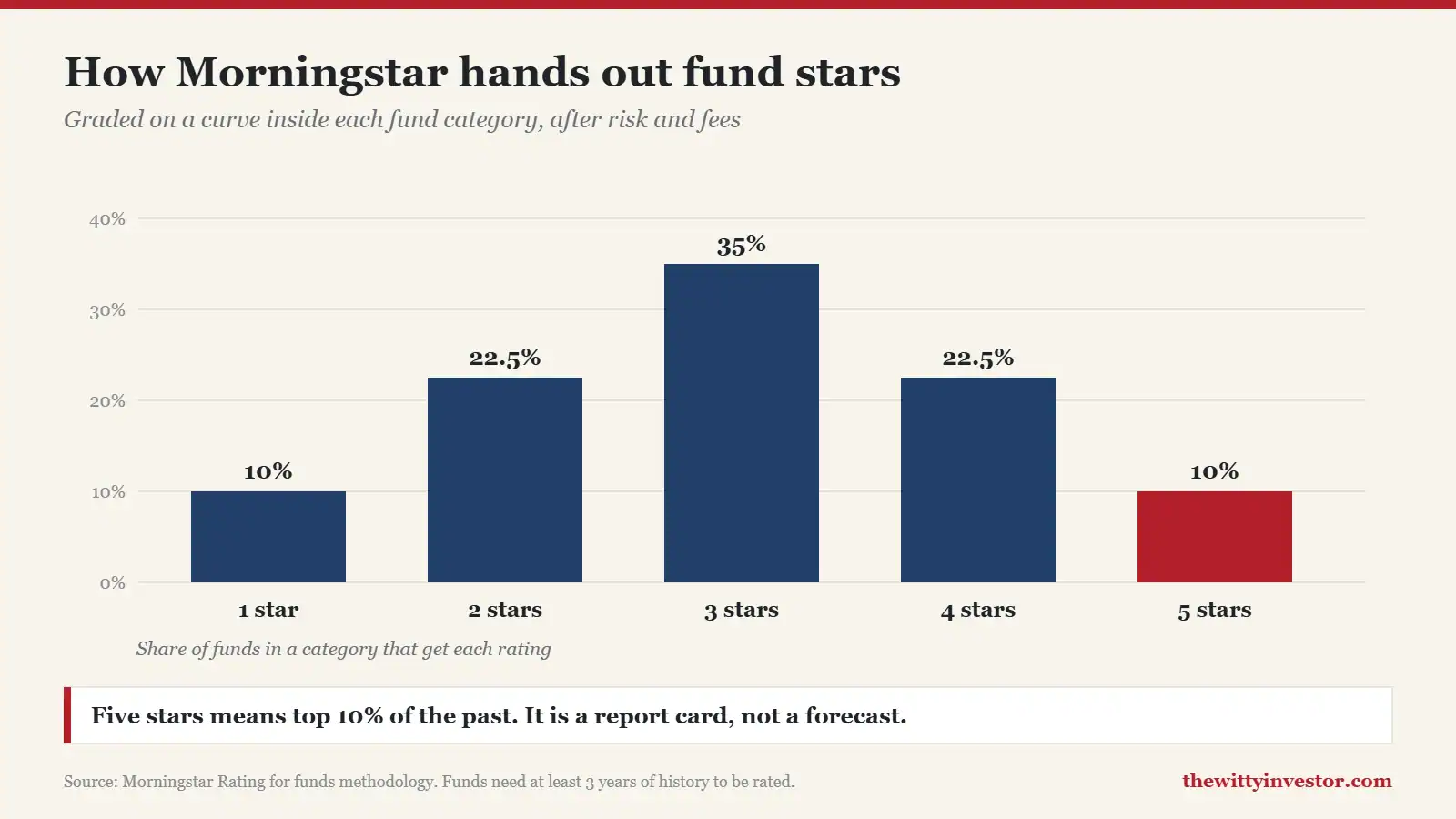
That curve is the most useful and most misunderstood thing on the site. Five stars means a fund beat its neighbors over the last three, five or ten years. It does not mean it will beat them over the next three. When The Wall Street Journal studied this, it found that only about 12% of five-star funds earned a top rating again over the following five years, as reported here. Morningstar’s response was, essentially, “we never said it predicts anything.” Which is true. They did not. The ad agencies did.
So I use the stars the way Morningstar says to: as a first filter. If I am comparing dividend funds or dividend ETFs, a one- or two-star rating tells me a fund has lagged its peers after costs for years, and I want to know why before I go any further. It narrows the list. It does not make the decision.
Stock Fair Value Estimates
This is the other half of what I use, and honestly the more interesting half. Morningstar’s analysts build a cash flow model for each company they cover and land on a single number: what they think one share is worth today. That is the fair value estimate. Then they compare it to the market price.
Per Morningstar’s stock quote help page, the stock star rating comes from that comparison. Trade well below fair value and the stock earns more stars. Trade well above it and it earns fewer. Three stars means the analysts think you would get a fair return for the risk, nothing more. The rating updates every evening after the market closes.
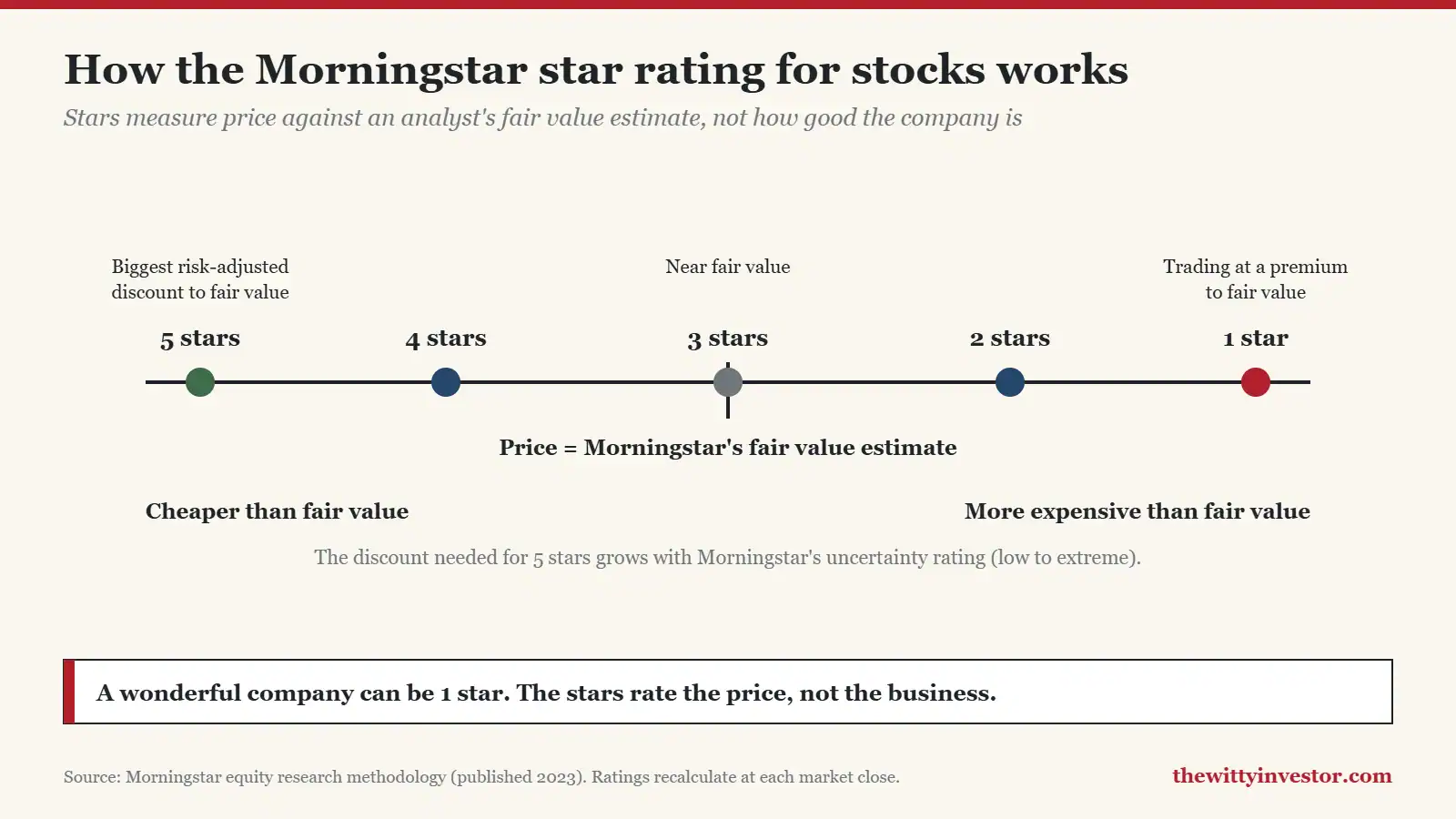
The clever part is the Uncertainty Rating, which runs from Low to Extreme. A predictable company like a spice maker needs only a modest discount to earn five stars. A company whose future depends on one lawsuit or one product needs a much bigger discount first. That is a built-in margin of safety, and it is the kind of thing I would put in my own spreadsheet if I had the patience to build a cash flow model for every company I own. I do not. That is rather the point of Morningstar.
For a dividend investor, this is genuinely handy. A stock with a juicy yield and a one-star rating is a stock the analysts think is priced for perfection, and I have written before about why chasing yield goes wrong. A quick look at fair value is a cheap sanity check before I add to a position.
Why I Trust It
My one-word take on Morningstar is “trustworthy,” and here is the plain reason. Its incentives are boring. It does not earn more when you trade more. It does not make a living picking two hot stocks a month. It publishes how its ratings work, in long and deeply unexciting methodology documents, and it puts out negative ratings on funds that fund companies would rather it did not.
Trustworthy is not the same as right. Analysts miss. Fair values get revised. Five-star funds fall back to three. But when Morningstar is wrong, it is wrong in the open, using a method I can read. In an industry full of ring lights and “this stock will 10x,” that is rarer than it should be.
What $249 a Year Adds
Medalist Ratings
If star ratings look backward, Medalist Ratings try to look forward. Funds get Gold, Silver, Bronze, Neutral or Negative based on Morningstar’s view of the people running the fund, its process, the company behind it, and its price. Some ratings come straight from an analyst. Others come from a model trained to mimic analysts, and Morningstar shows how much of each rating was analyst-driven. It refreshed the methodology this year; the announcement says the update went live globally in April 2026.
This is the feature that tempts me most, because “who is running this fund and are they any good” is exactly what stars cannot tell you. For someone who owns a handful of index funds, though, the answer is usually “a computer, and yes.”
Full Analyst Reports
Investor unlocks the full write-ups behind the ratings: the economic moat, the reasoning behind the fair value, and the analyst notes when something changes. The headline number is useful. The reasoning is what tells you whether to believe it. If you buy individual stocks and want to understand a company in twenty minutes instead of a weekend, this is the best part of the subscription.
Portfolio X-Ray
X-Ray looks inside every fund you own and adds it all up, so you can see your real mix of sectors, regions and individual stocks. It is how you find out that your S&P 500 fund, your growth fund and your “diversified” tech ETF all own the same seven companies. Surprise, you have one portfolio wearing three hats. If you hold several funds, this is the feature most likely to be worth the money.
Screeners and Watchlists
You also get full screeners for stocks, funds and ETFs that can filter on Morningstar’s own ratings, plus watchlists and alerts. Useful. Not unique. Your broker probably has a free screener already, and my dividend tracker roundup covers cheaper ways to watch what you own.
Morningstar Investor Pricing and Fine Print
Morningstar Investor lists at $249 a year or $34.95 a month on its pricing page. Paying monthly works out to $419.40 a year, which is $170 extra for the privilege of not committing. Promotions regularly knock the first year down to $199.
Now the fine print, straight from the terms:
- The trial is 7 days, once per lifetime. It ends at 11:59 p.m. Central, seven days after it starts. If you have ever taken one, you get charged on day one instead.
- Promo prices are first-year only. After that it renews at whatever the list price is at the time.
- Prepaid subscriptions are non-refundable. Cancel mid-year and you keep access until the year ends, but you do not get money back.
- You can cancel online. My Account, then Subscription, then Cancel. You can also call or email. Bought it through the iPhone app? Then you cancel through Apple, not Morningstar.
Credit where due: online cancellation and a clear trial end time are better than a lot of this industry manages. Still, the real question is not “should I try it.” It is “am I sure about $249, because I am not getting it back.”
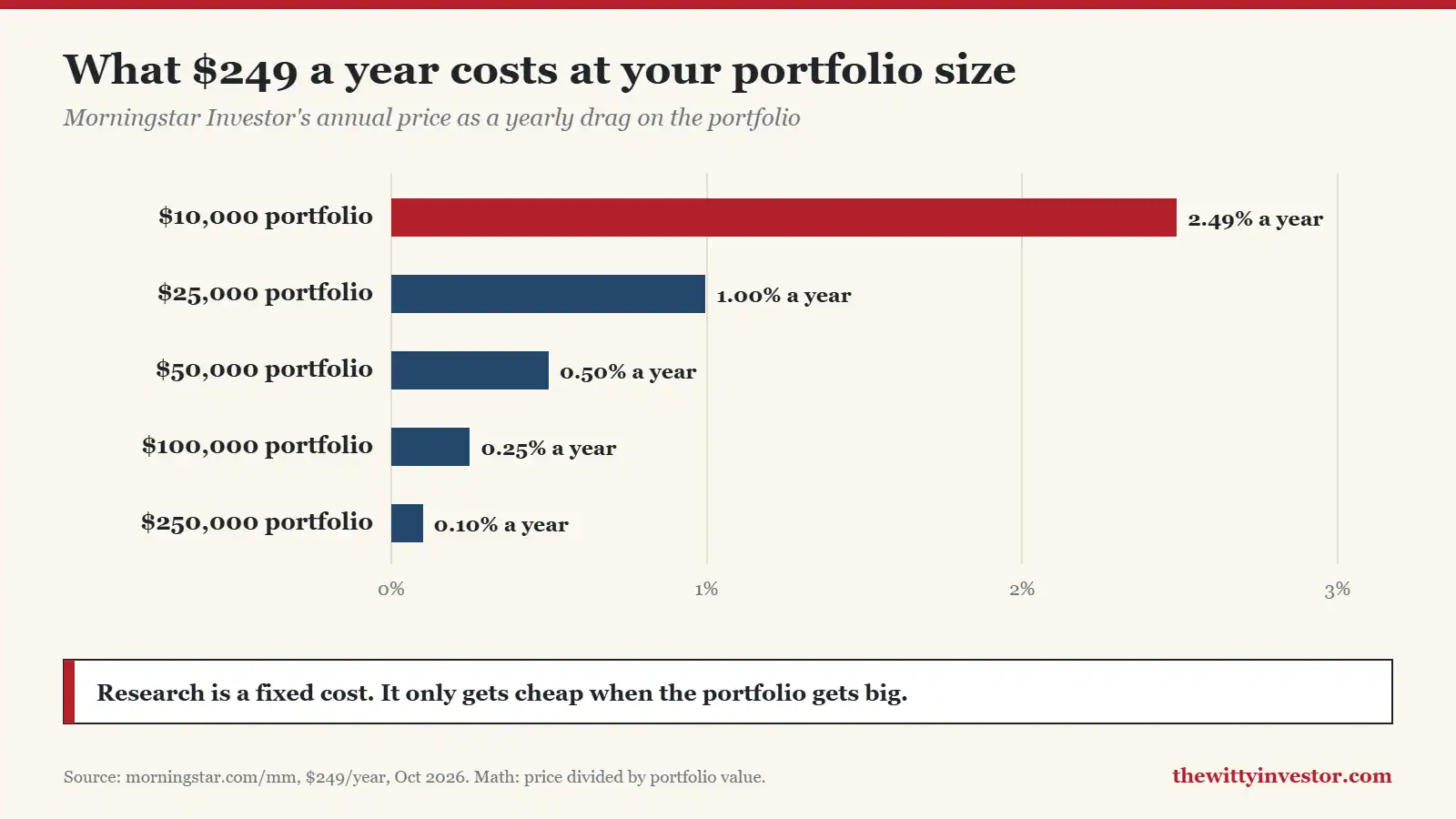
That chart is how I price every research subscription. On a $10,000 portfolio, $249 is a 2.49% yearly cost before you make a single good decision. That is more than many dividend stocks yield. On $100,000 it is 0.25%, and one avoided mistake pays for years of it. Same price. Completely different deal.
Here is the version that stings for me. At a 3.5% yield, $249 is the yearly dividend on about $7,100 invested. I am trying to get to $1,000 a month in dividends. Spending a quarter of one month’s goal on research I can mostly see for free is not a trade my spreadsheet will approve.
Pros and Cons
- Pro: the most trustworthy, most transparent ratings in retail investing
- Pro: fair value estimates with a built-in margin of safety, not just a price target
- Pro: Portfolio X-Ray is the best way to find hidden overlap across your funds
- Pro: you can cancel online, and the trial end time is spelled out
- Con: $249 a year is a lot for a small portfolio, and $419.40 if you pay monthly
- Con: no refunds on prepaid plans, and the trial is one per lifetime
- Con: star ratings look backward, and five-star funds rarely stay five-star
- Con: if you own two or three index funds, there is not much left for it to tell you
Who Morningstar Investor Is For, and Who Should Skip It
Worth a look if you:
- Own several funds and want X-Ray to show what you actually hold
- Buy individual stocks and want the reasoning behind each fair value, not just the number
- Have a portfolio large enough that $249 is well under 1% a year
Skip it if you:
- Own a few index funds or ETFs. You need a cheap broker, not fund research. Start with the best brokerages for dividend investing.
- Mostly want star ratings and a quick fair value check. That is already on the free side.
- Have a portfolio where $249 is a bigger yearly cost than your fund fees. My fee drag calculator will show you what that does over 20 years.
Morningstar Investor vs. the Alternatives
Seeking Alpha Premium costs $299 a year and runs on crowd-sourced articles plus a quant model. It is louder, busier and better for finding arguments about a stock. Morningstar is calmer, more fund-friendly and built on its own analysts. If I were forced to pay for one, I would pick Morningstar, and I would grumble about it.
Before you pay either, check your broker. Some brokers show Morningstar ratings to their customers, and a few hand out full Morningstar reports for free. If you want help tracking dividends rather than researching them, a dividend tracker app does it for far less. And for AI-assisted research, the best AI investing tools cover what that can and cannot do. Or, and I say this with love, a spreadsheet.
Frequently Asked Questions
Is Morningstar Investor worth it?
For most buy-and-hold investors, no. It is worth $249 a year mainly if you own several funds and will use Portfolio X-Ray, or you buy individual stocks and want full analyst reports, and your portfolio is big enough that the price is a small fraction of a percent.
How much does Morningstar Investor cost?
$249 a year or $34.95 a month at list price, as of November 2026. Monthly billing adds up to $419.40 a year. First-year promotions often bring the annual plan to $199, and it renews at the then-current list price.
Does Morningstar Investor have a free trial?
Yes, 7 days. It ends at 11:59 p.m. Central seven days after it begins, and you only get one. If you have taken a trial before, you are charged as soon as you sign up.
Can I get a refund on Morningstar Investor?
Not on a prepaid plan. Morningstar’s terms say prepaid subscriptions are non-refundable. If you cancel, you keep access until the end of the period you paid for.
What is the difference between Morningstar star ratings and Medalist Ratings?
Star ratings grade a fund’s past risk-adjusted returns against similar funds. Medalist Ratings (Gold, Silver, Bronze, Neutral, Negative) are forward-looking, based on the fund’s people, process, parent company and price.
How does Morningstar calculate fair value?
Analysts estimate the cash a company will generate in the future and discount it back to today. The stock’s star rating then compares the market price with that fair value, with a bigger discount required for companies whose future is harder to predict.
Are Morningstar ratings reliable?
They are transparent and independent, which is why I trust them. They are not predictions. Star ratings reflect past performance, and fair values are analyst estimates that get revised. Use them as a starting filter, not a final answer.
Bottom Line: My Morningstar Investor Verdict
USE the free side, WAIT on the subscription. Morningstar is the research company I trust most, because its incentives are boring and its methods are public. The free fund ratings and fair value checks cover most of what a dividend investor like me needs. Investor adds real tools, especially Medalist Ratings, full analyst reports and Portfolio X-Ray, but at $249 a year with no refunds, it only makes sense when your portfolio is big enough, and your fund list long enough, to put them to work.
If you do try it, run X-Ray on your real holdings on day one, read the full report on one stock you actually own, and set a cancel reminder for day 5. As for me, I will keep checking the stars, keep my spreadsheets, and keep the $249 working in something that pays me a dividend instead.
Want the next one in your inbox? The Verdict newsletter sends one honest take a week. No hype, no five-star ads.