A Betterment review that reads the fee schedule instead of the brochure. 2 numbers, 1 switch, a $75 exit door, and a pricing page that occasionally disagrees with itself.
You have $8,000 in a savings account. It has been there long enough to develop opinions. You would like it invested, but you would also like to never think about it again, which rules out the brokerage app with the flashing green numbers and the guy on YouTube who calls everything “a generational setup.”
So you land on Betterment. Calm colors. A slider. A promise that it handles the boring parts. The boring parts are, in fact, the entire job.
The question is not whether Betterment works. It does what it says. The question is what it costs at your balance, and that answer changes more than the homepage lets on. Let’s read the fine print. (Yes, all of it. No, it did not make me feel better about the word “boost.”)
Experience label: Researched. TWI has not opened or funded a Betterment account. Everything below comes from Betterment’s own fee schedule, help pages and regulatory filings, checked in November 2026. Here’s how TWI labels reviews.
Betterment Review: The Verdict Up Front
| Product | Betterment (Digital and Premium automated investing) |
| Verdict | PASS if you’ll set up a $200 monthly recurring deposit or already have $24,000+. WAIT if you have a small balance and no plan to add to it. SKIP Premium unless you’ll actually use the advisor. |
| Best for | Investors who want a diversified ETF portfolio, automatic rebalancing and tax-loss harvesting, and who know they’ll tinker if given buttons |
| Price | $5 per month, or 0.25% a year with a $200+ monthly recurring deposit or a $24,000+ balance. Premium is 0.65% with a $100,000 minimum. Check Betterment’s pricing page. |
| The catch | The flat $5 fee is expensive on small balances, and moving investments out costs $75 per account |
| Experience label | Researched (not tested with a funded account) |
Short version: Betterment is reasonably priced for the person it was built for and quietly expensive for the person it markets to hardest, which is the beginner with a small balance.
What Is Betterment?
Betterment is a robo-advisor. You answer questions about goals and timeline. It builds a portfolio of low-cost ETFs, keeps it at your target mix, reinvests dividends, and harvests tax losses in taxable accounts. You get a dashboard and a strong suggestion to stop looking at it.
Think of it as hiring someone to Marie Kondo your portfolio every day while you’re at work. The portfolio does not get a vote.
It also sells things next to the investing: a Cash Reserve account, checking, crypto exposure through ETFs, and a self-directed stock account. Those matter because they affect how your fee is calculated, which we’ll get to.
Who Runs Betterment?
Betterment is a New York company that launched in 2010 and is one of the oldest robo-advisors still standing. In 2025 it bought Ellevest’s automated investing business, which tells you it’s consolidating, not shrinking.
The less glossy entry in the record: in 2023 the SEC said Betterment made misstatements about its tax-loss harvesting service and failed to harvest losses for some clients for a period, and Betterment agreed to pay $9 million to settle. Betterment says it fixed the issues and reimbursed affected clients. Worth knowing, because tax-loss harvesting is one of the main reasons people pick it.
Top Benefits of Betterment
- No trading commissions or account maintenance fees on top of the advisory fee, per the fee disclosure
- Automatic rebalancing, so your stock-bond mix doesn’t wander off while you’re busy
- Tax-loss harvesting in taxable accounts
- Fractional shares, so every dollar gets invested
- A $0 account minimum, with about $10 to start investing
Best Features of Betterment
Rebalancing That Happens Without You
Your target is, say, 80% stocks and 20% bonds. Markets move. A year later you’re 86/14 and didn’t notice. Betterment trades you back. This is the single most useful thing it does, and it is the thing DIY investors most often forget to do themselves. Not because it’s hard. Because it’s boring, and boring loses to everything.
Tax-Loss Harvesting
When a holding in a taxable account drops, Betterment can sell it, book the loss for your tax return, and buy a similar fund so you stay invested. Betterment claims that most customers using it had their advisory fee covered by likely tax savings in 2022, per its Premium page. That’s a company statistic about 1 unusually bad market year, so treat it as a best case, not a forecast.
Note the fine print in that sentence: taxable accounts only. In an IRA or 401(k) rollover, tax-loss harvesting does nothing for you. If all your money is in retirement accounts, one of Betterment’s headline features doesn’t apply to you.
Cash Reserve and the Fee Line
Betterment doesn’t charge an advisory fee on cash. Cash Reserve showed a variable 3.50% APY as of 9/21/2026 on Betterment’s pricing page, with a temporary boost for new clients (see the Cash Reserve program terms). Rates move, so check before you rely on it. If you’re building a cash cushion, the logic in TWI’s guide to sizing an emergency cash reserve applies here too.
Here’s the fine print worth your coffee: the pricing page says the $24,000 threshold counts balances across your investing accounts “including Cash Reserve,” while the FAQ on the same page says Cash Reserve is excluded from the fee calculation. Both can’t be right. If your plan depends on Cash Reserve pushing you over $24,000, ask Betterment in writing first.
Betterment Pricing: The Actual Math
Betterment’s Digital plan has 2 prices, and which one you pay depends on your balance and your habits.
- $5 per month if your balance is under $24,000 and you don’t have a $200+ monthly recurring deposit
- 0.25% a year if you have $24,000 to $1 million, or a $200+ monthly recurring deposit
- Premium: 0.65% a year, with a $100,000 minimum, for unlimited access to certified financial planners
- Above $1 million: 0.15% on the portion from $1 million to $2 million, and 0.10% above $2 million
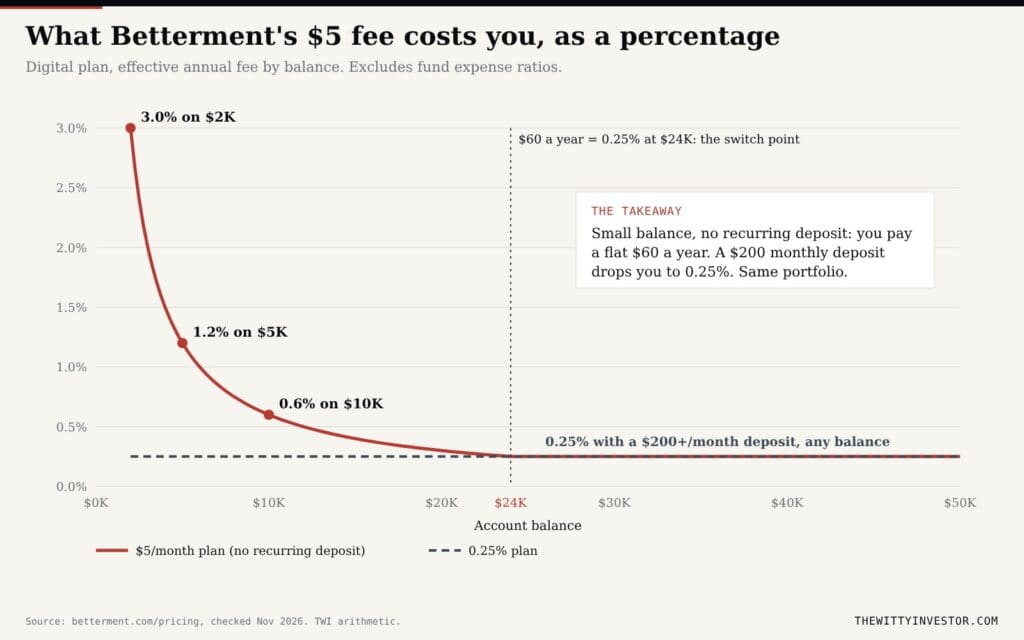
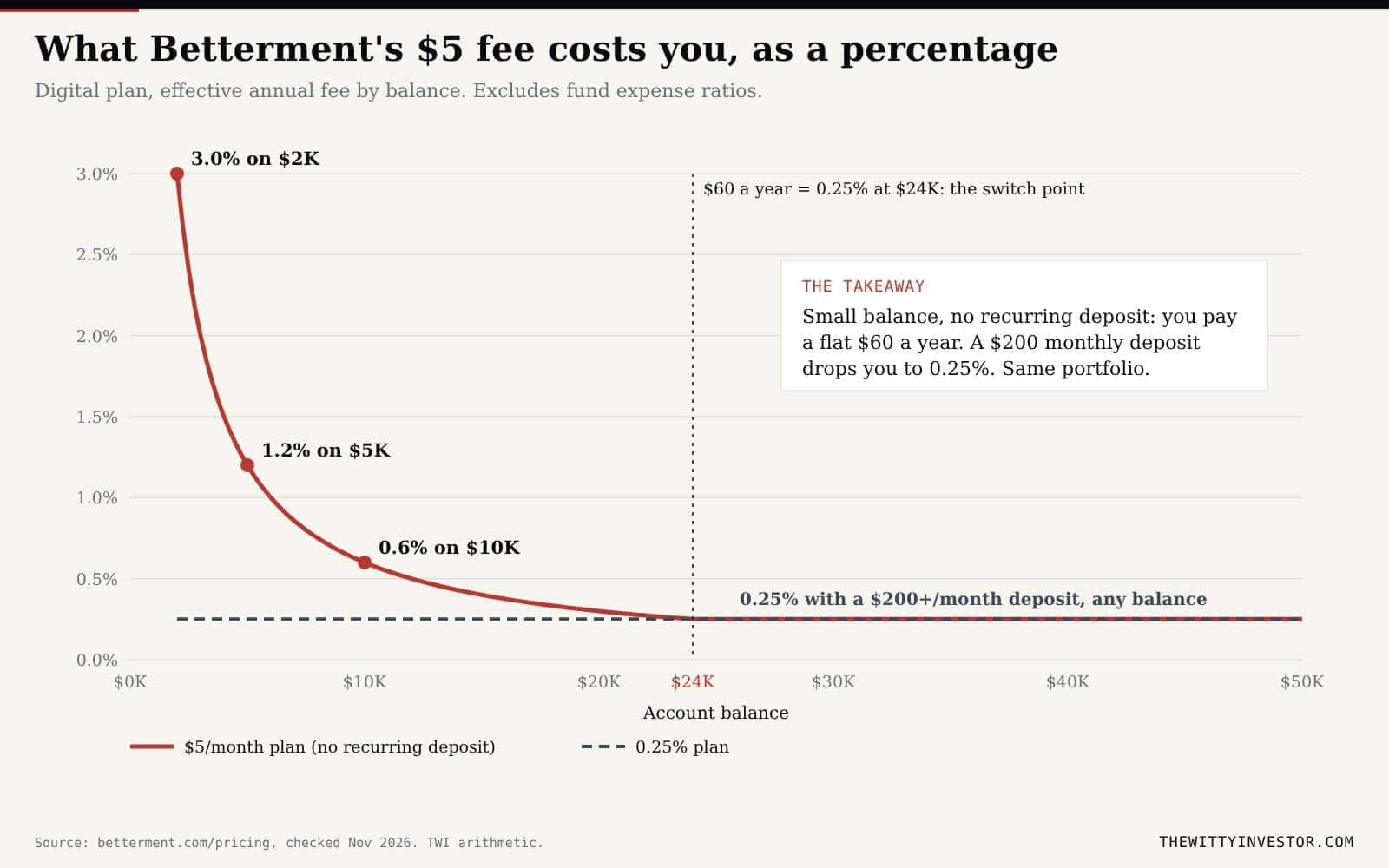
The $5 is the number to watch. It’s $60 a year, flat. On $24,000, that’s exactly 0.25%, which is where the switch sits. Below that, the flat fee gets more expensive as a percentage the smaller you are:
| Balance | No recurring deposit | With $200+/month recurring deposit |
|---|---|---|
| $2,000 | $60/yr (3.0%) | $5/yr (0.25%) |
| $5,000 | $60/yr (1.2%) | $12.50/yr (0.25%) |
| $10,000 | $60/yr (0.6%) | $25/yr (0.25%) |
| $24,000 | $60/yr (0.25%) | $60/yr (0.25%) |
| $50,000 | $125/yr (0.25%) | $125/yr (0.25%) |
| $100,000 (Premium) | $650/yr (0.65%) | $650/yr (0.65%) |
TWI’s arithmetic from Betterment’s published rates. Excludes fund expense ratios.
So the person paying 1.2% a year is the beginner with $5,000 who opened an account and stopped there. That’s the classic robo-advisor pitch, aimed at exactly the person the pricing hits hardest. The fix costs nothing: set up a $200 recurring deposit and the same $5,000 costs $12.50 a year instead of $60. Same portfolio, same app, 1 checkbox.
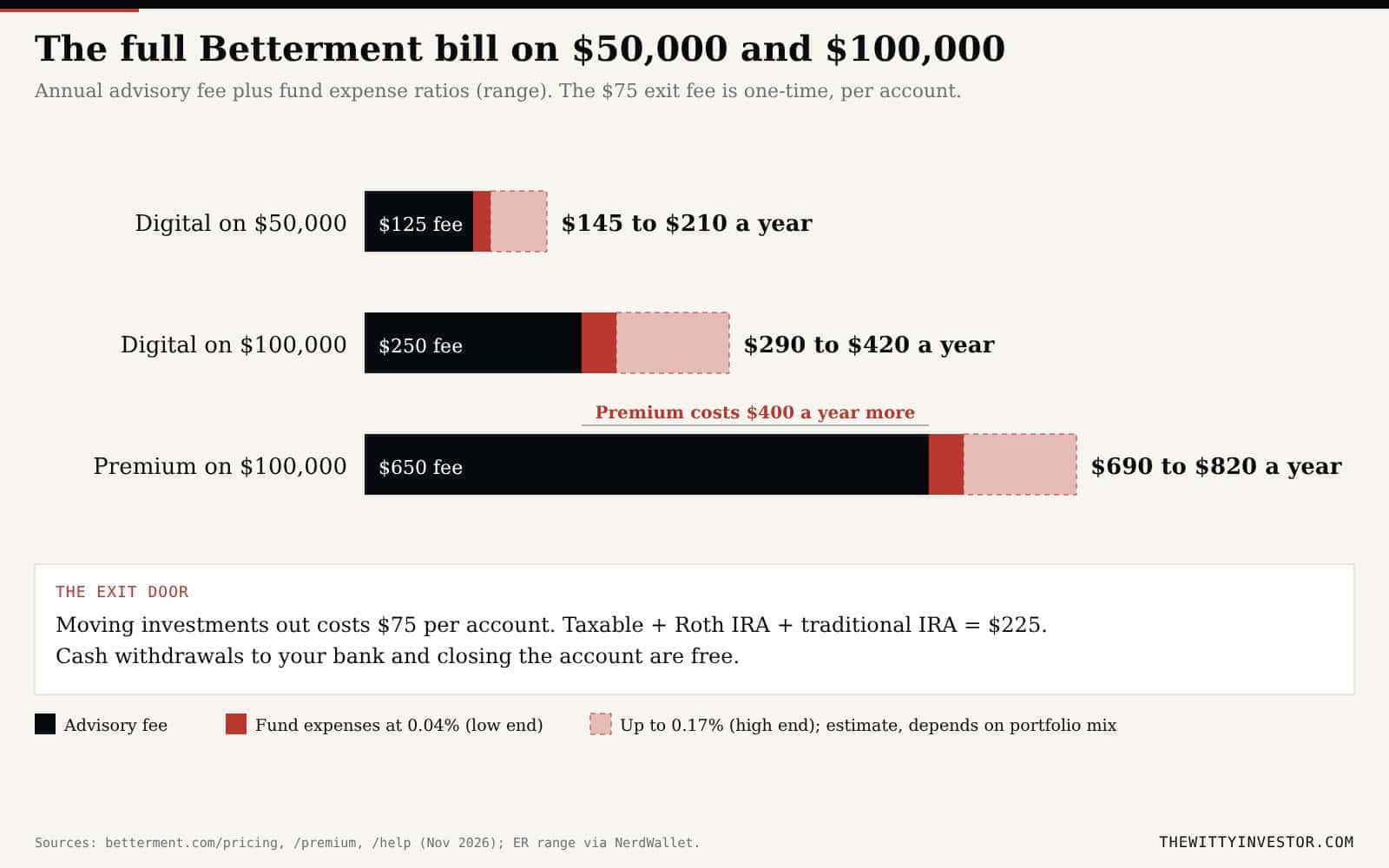
On top of the advisory fee you pay the funds’ own expense ratios. NerdWallet lists 0.04% to 0.17% for the Core portfolio. On $50,000, that’s roughly $20 to $85 a year more, depending on the mix. Small, but real, and it doesn’t appear in the headline price.
Run your own balance through TWI’s fee drag calculator to see what 0.25% versus 0.65% costs over 20 years. The gap compounds, which is a word that sounds lovely right up until it’s working against you. (If it’s been a while, here’s how compound interest actually works.) When you’re ready, see Betterment’s current pricing.
The $75 Exit Fee
Betterment charges a flat $75 for each investing account transferred to another company. Withdrawing cash to your bank or closing the account is free. Moving the actual investments out, which you’d do to avoid selling and triggering taxes, is not.
2 more details from the help pages. On a full in-kind transfer, leftover fractional shares are sold and any accrued fees come out of the proceeds, per Betterment’s outbound transfer FAQ. And some of those help pages still quote older pricing ($4 a month, a $20,000 threshold, a $250 deposit). The current numbers are on the pricing page. That’s not sinister. It’s just a reminder that companies update the brochure faster than the manual.
$75 isn’t outrageous. It’s in line with what many brokerages charge, as TWI covered in its breakdown of brokerage transfer fees. Some receiving brokers will reimburse it if you ask. But if you have 3 accounts at Betterment, a taxable, a Roth IRA and a traditional IRA, leaving costs $225. Plan the exit before you plan the entrance.
Betterment Review: Pros and Cons
Pros
- 0.25% is a fair price for automated rebalancing and tax-loss harvesting at $24,000 and up
- No commissions or account maintenance fees on top of the advisory fee
- The $200 recurring deposit unlocks the percentage rate at any balance, which rewards the right habit
- Self-directed investing carries no management fee and no trading commissions
Cons
- The $5 monthly fee works out to 1.2% a year on $5,000 and 3.0% on $2,000
- $75 per account to transfer investments out, so 3 accounts cost $225 to leave
- Premium costs $400 a year more than Digital on $100,000, for advisor access you may use twice
- Tax-loss harvesting only helps in taxable accounts
- The pricing page contradicts itself on whether Cash Reserve counts toward the $24,000 threshold
What Betterment Is Not
Every honest Betterment review needs this section, because most of the disappointment comes from expecting the wrong product.
It’s not a dividend income machine. Betterment builds a total-return portfolio. If your plan is a hand-picked basket of dividend payers you can name at dinner parties, this isn’t the tool. TWI’s dividend stock analysis is where that conversation lives.
It’s not a financial planner, unless you pay for Premium. Digital gives you goal tools and a portfolio. It won’t tell you whether to pay off the mortgage.
It’s not magic tax alpha. Tax-loss harvesting defers taxes. It doesn’t erase them. The benefit is real in taxable accounts and depends heavily on your tax bracket and the market’s mood.
It’s not cheaper than doing it yourself. A single all-in-one fund at a big brokerage costs less. You’re paying Betterment to stop you from being you.
Betterment Alternatives
M1 Finance is the closest comparison and the opposite philosophy. You design the portfolio; M1 automates the deposits and rebalancing. TWI did the full side-by-side in M1 Finance vs. Betterment, including costs at every balance. If you already like picking your own funds, read TWI’s M1 Finance review before you commit to anyone.
Wealthfront is Betterment’s most direct robo rival. Check its current pricing page before comparing; the useful question is which tax features you’ll actually use.
A target-date fund at a large brokerage does the rebalancing part for an expense ratio and no advisory fee. No tax-loss harvesting, no app pep talks. For a retirement account where TLH doesn’t apply anyway, this is the strongest competitor Betterment has.
Empower is the pick if what you actually want is a human advisor and 1 dashboard for everything, though its advisory pricing is a different league. See TWI’s Empower review.
Betterment in Practice: What the Fine Print Demands of You
What TWI Has and Hasn’t Done
TWI hasn’t funded a Betterment account, so there’s no “6 months in” diary here, and there won’t be one until there’s a real account behind it. What the fee schedule does tell you is what Betterment expects from a user to be good value:
- A recurring deposit of $200 or more, or a balance above $24,000. Without one of those, you’re on the $5 plan.
- At least some taxable money, if tax-loss harvesting is part of why you’re here.
- Patience. The product earns its fee by stopping you from trading. If you’ll override it every time the market sneezes, you’re paying 0.25% for a very expensive suggestion box.
- A long stay. The $75-per-account exit fee makes Betterment a poor place to park money for 1 year while you “figure things out.”
Conclusion: Should You Use Betterment?
This Betterment review lands on a verdict that depends on 1 setting.
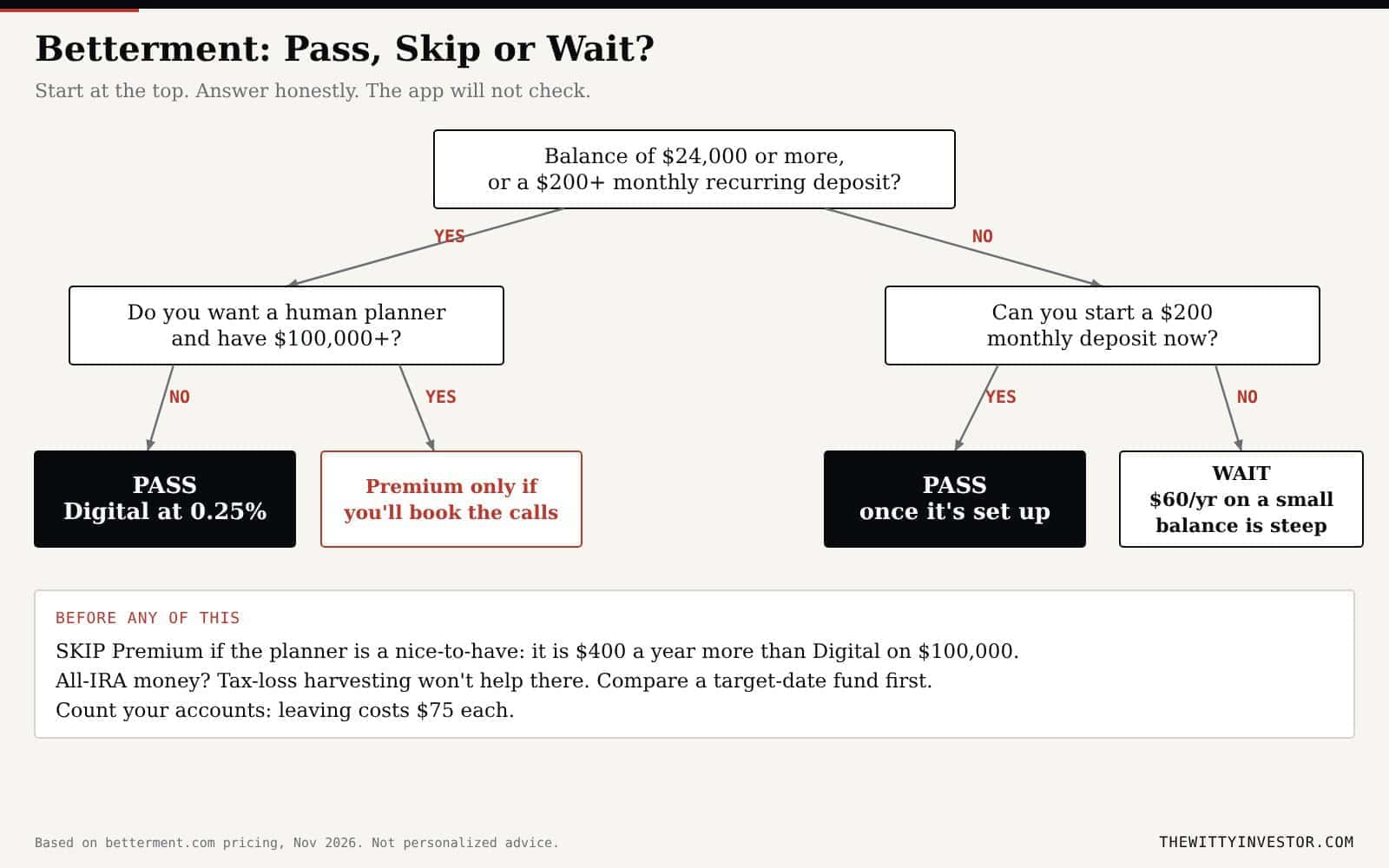
PASS if you’ll keep a $200+ monthly recurring deposit, or you already have $24,000 or more. At 0.25%, you get rebalancing, tax-loss harvesting and no commissions for a fair price.
WAIT if you have a small lump sum and no plan to add to it. Paying $60 a year on $3,000 is a 2% head start in the wrong direction. Build the habit first, or start the recurring deposit on day 1.
SKIP Premium unless you’ll book the planner calls. At $100,000, it’s $400 a year more than Digital. That’s a lot of money for a phone number you don’t dial.
Your move this week: write down your balance, decide whether you’ll actually automate $200 a month, and count how many accounts you’d move in. Then open a Betterment account, or don’t. Either way, you’ll be deciding on the math, not the slider.
Betterment Review FAQ
Is Betterment worth it in 2026?
For balances of $24,000 or more, or anyone with a $200+ monthly recurring deposit, Betterment’s 0.25% fee is fair for what it automates. Below that, without a recurring deposit, the flat $5 monthly fee is expensive as a percentage.
How much does Betterment cost per year?
Digital costs $5 a month ($60 a year) or 0.25% a year if you have $24,000+ or a $200+ monthly recurring deposit. Premium costs 0.65% a year with a $100,000 minimum. Fund expense ratios are extra.
Does Betterment charge a fee to transfer out?
Yes. Betterment charges a flat $75 for each investing account transferred to another firm. Withdrawing cash to a linked bank account or closing the account is free.
What’s the minimum to open a Betterment account?
There’s no account minimum, and you need about $10 to start investing. Premium requires a $100,000 balance.
Is my money safe at Betterment?
Betterment Securities is a member of SIPC, which protects securities up to $500,000 if the brokerage fails. It doesn’t protect against market losses. Cash Reserve is swept to program banks for FDIC coverage; the limits are in Betterment’s FDIC and SIPC disclosures.
What did this Betterment review find in the fine print?
3 things: the $5 fee is steep on small balances, the $75 exit fee applies per account, and the pricing page contradicts itself on whether Cash Reserve counts toward the $24,000 threshold.
Not personalized investment advice. Fees and rates change; confirm current terms on Betterment’s site before you open anything. See the financial disclaimer and affiliate disclosure.
Prices and terms checked November 2026. Reviews on The Witty Investor are labeled Tested, Owned or Researched. This one is Researched.